This updated Ask Dr. Universe story originally published February 2022.
Dear Tara,
When you think of the Jurassic period, you might think of dinosaurs. But all kinds of insects roamed the Earth back then. That includes the ancient relatives of praying mantises.
Some mantises died and fossilized into rock or amber. That preserved them for hundreds of millions of years. Now those fossils help us learn about ancient and modern insects.
That’s what my friend Elizabeth Murray told me. She’s an insect scientist at Washington State University.
She said that scientists also study insect DNA. That gives us clues about how insects changed over time. It helps us map what ancestors different insects have in common.
It turns out mantises share a common ancestor with cockroaches.
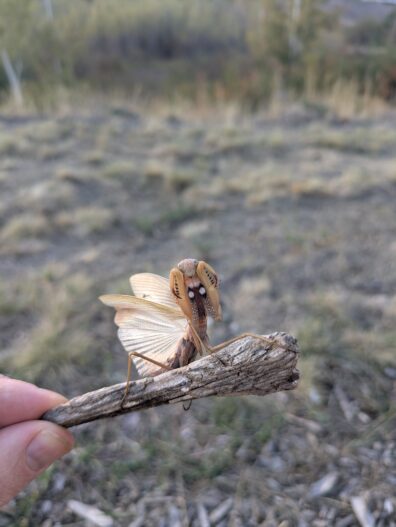
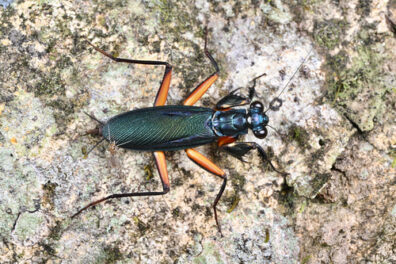
Today’s praying mantises mostly sit upright. They ambush their prey and grab them with raptor-like forelegs. But some mantises (metallyticus genus, right) still have flattened bodies and roach-like hunting behaviors. ©Larry Clark CC BY-NC, ©dazaoaaaa CC BY-NC
“We have evidence that’s come together and shown that cockroaches and mantises are most closely related,” Murray said. “They had a common ancestor. It maybe even looked like a mix of both insects.”
Mantises and roaches have one big trait in common. They build tough egg cases—called oothecas.
To form that egg case, they first make a frothy goo. They lay eggs with a short egg-laying organ, or ovipositor. They secrete the goo at the same time. Then, the goo hardens. It protects the tiny eggs from danger—like parasites, predators or weather. Some roaches carry their egg cases around to keep them extra safe.
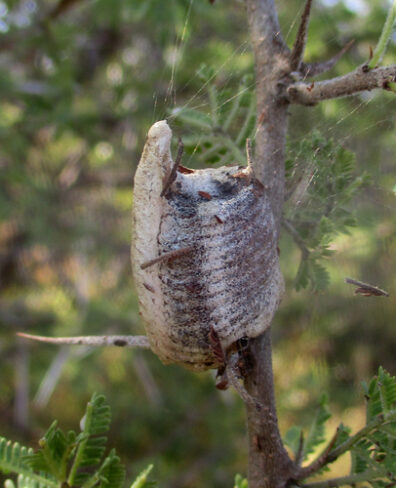
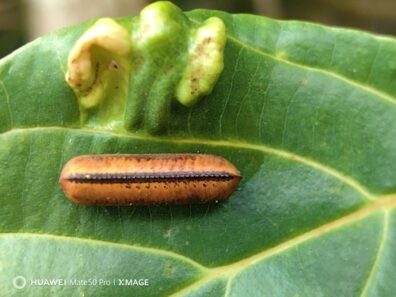
A mantis egg case (left) tends to feel like Styrofoam. A roach egg case (right) usually feels more leathery. ©botswanabugs CC BY-NC, ©siaoon CC BY-NC
Over millions of years, new traits like egg cases helped different insects survive. They passed those traits on to their babies. A shared trait from a common ancestor is called a synapomorphy.
Mapping shared traits helps scientists build insect family trees. That’s how they figured out that mantises and roaches form a group called Dictyoptera.

This family tree, or cladogram, shows that mantises and roaches are related. They’re sister groups.
Their common ancestor was a roach-like insect. Scientists think it had a long ovipositor and laid individual eggs. It probably didn’t make hard egg cases.

This extinct “roachoid” left a flattened imprint on rock formations. Scientists can even see its wing veins. Insects don’t have bones, so they don’t leave the same kinds of fossils as dinosaurs. ©Hornig et al. CC BY 4.0
That adaptation would come later. Over millions of years, roaches and mantises became more and more different from their shared ancestor and each other.
That’s what happened with termites, too. They also belong in Dictyoptera. They’re a kind of specialized, social cockroach. They’ve changed so much that they mostly don’t make egg cases anymore. Just one living termite species still does that.
Figuring out evolutionary relationships based on traits is called cladistics. Keep asking questions, and someday you ter-might become an expert in insect family trees.
Sincerely,
Dr. Universe