Dear Morgan,
Like me, lions and tigers have sharp teeth and retractable claws. They sometimes use those fierce claws to knead or make biscuits. They enjoy a nap and good grooming sesh.
That’s not surprising because house cats share about 95% of their DNA with big cats. All cats belong to the family Felidae.
But that family is complicated. I asked my friend Haden Kingrey how house cats came to be. He’s an anthropology doctoral student at Washington State University. He studies artifacts to understand the past.
Kingrey told me that house cats are the result of evolution and domestication.
In any group of living things, some individuals have traits that help them thrive. They’re more likely to survive and reproduce—and pass those traits on to their babies. That’s natural selection.
Over time, the group changes. Super useful traits become more common. This long-term change is evolution. Eventually, a group may change so much that it becomes a whole new species.
That’s what happened with house cats. Their ancestors changed over time until they were a new species. But those ancestors weren’t big cats.
“House cats didn’t evolve from lions or tigers or saber-toothed cats,” Kingrey said. “Instead, all these cats have a common ancestor.”
So, big cats and house cats are like distant cousins. Their common ancestor is the ancient relative they all share.
There were two important splits in the cat family tree. About 20 million years ago, the saber-toothed cats branched off from the ancestors of modern cats. Then 12 million years ago, modern cats broke off into big cats and smaller cats. The big cats were the ancestors of lions and tigers. The smaller cats were the ancestors of cougars, panthers and African wildcats.
Smaller cats had a few advantages. They need less food. Plus, they’re spry. Massive lions are successful hunters just 20% of the time. But African wildcats bring down a whopping 60% of their prey.
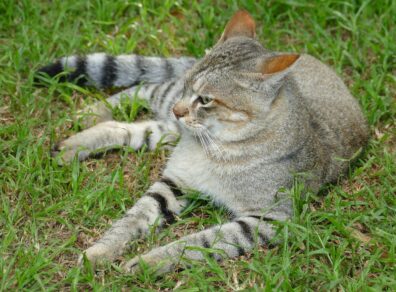

On the left is an African wildcat (Felis silvestris). On the right is my roommate, a house cat (Felis catus). They look remarkably alike but have important genetic differences. Bernard Dupont CC BY-SA 2.0
_female_..._(captive_specimen)_(39789072173).jpg)
Those nimble African wildcats are the direct living ancestor of all house cats.
“The way we get to house cats from the African wildcat is domestication, which is artificial selection,” Kingrey said. “This is humans making choices.”
Nearly 12,000 years ago, some humans changed how they lived. Instead of foraging and hunting, they settled down and began farming. They grew and stored grain, and mice showed up to nibble on it. The local wildcats jumped on the opportunity—literally.
Soon, wildcats and farmers formed a partnership. The cats killed mouse pests. The humans provided an easy place to hunt. Over time, some wildcats developed new traits that strengthened their bonds with humans. Eventually, they were so different from wildcats that they became a new species: the house cat.
Scientists can see 13 genes that separate today’s house cats from modern wildcats. They govern things like fearfulness and receptivity to food rewards.
Kingrey told me the oldest physical evidence of house cats is 9,500 years old. Scientists working at a dig site in Cyprus found a grave. Inside, a human and a cat were buried together.
That’s interesting because African wildcats aren’t native to Cyprus. So, those early cats must have traveled there with their human companions. There must be artifacts of earlier cat domestication out there, waiting to be found.
And it shows that cats and humans became besties pretty quickly. You could say we’re a purr-fect match.
Sincerely,
Dr. Universe