Dear Kristen,
This answer is fueled by coffee with a splash of milk from a dairy cow.
I asked my friend Kimberly Davenport why my morning milk doesn’t come from a beef cow. She’s an expert in cow genetics at Washington State University.
She told me that all cows are the same species: Bos taurus. But different kinds of cows have different traits—like making lots of milk or growing big muscles.
“Over time, we’ve selected these cows to either make more milk or more meat,” Davenport said.
Selecting means noticing the traits you like and keeping animals with those traits. When those animals reproduce, the babies will likely have those traits, too.
A dairy cow that makes gobs of milk will probably have babies that produce lots of milk. An extra muscly beef cow will probably have super beefy babies.
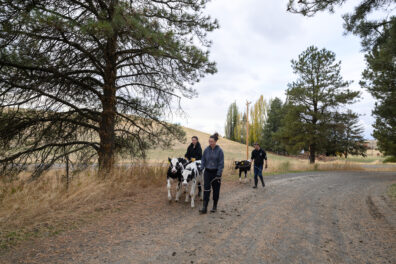
These baby cows live at WSU’s dairy. Students take them for walks to teach them to work with humans. Someday, their milk will become cheese or ice cream. © 2020 Washington State University
Today, technology helps select the milkiest or meatiest cows. Scientists like Davenport can test a cow’s DNA. They look for genetic markers linked to milk production or muscle mass.
That identifies cows that might be excellent dairy or beef cows. But DNA is only part of what makes cows—or anybody—who they are.
“It’s genetics and environment,” Davenport said. “You can have the best animal ever, genetically. But if you don’t take care of them, and their environment’s not correct, then they’re probably not going to be the best.”
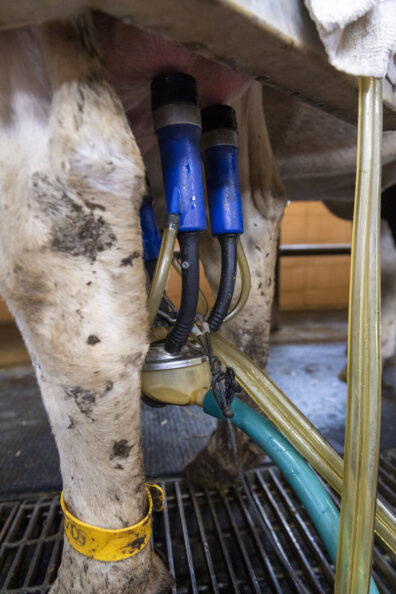
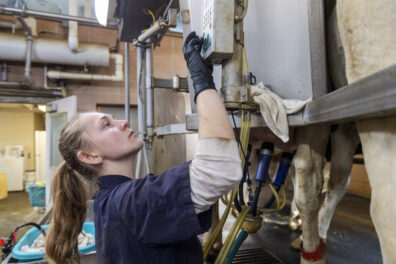
These dairy cows are milked using a robotic milking system. © 2020 Washington State University
A baby cow gobbles up about a gallon of milk every day. Most beef cows make just enough milk for those calves.
But dairy cows make about 6 to 8 gallons of milk every single day. That’s a lot of extra milk for my coffee.
To manage all that moo juice, farmers milk dairy cows two or three times every day.
“They love getting milked,” Davenport said. “We’ll go out to the dairy, and they’ll be standing at the gate like, ‘Okay, we’re ready!’”
That makes sense because being full of milk isn’t super comfortable—and baby cows can only drink so much. Plus, dairy cows chow down on treats while they’re milked.
But most importantly, mammal brains have adapted to make milk. When a dairy cow feeds its calf or gets milked, a chemical message zooms through its brain and body. That chemical message—oxytocin—is sometimes called the love hormone. It releases milk. It also calms the cow. It gives her good feelings about the calf or the person milking her.
Selection probably influences how dairy cows respond to milking, too. Scientists and farmers can select for a cow’s personality traits. They can pick out cows likely to pass on friendliness to their babies. Calm, friendly cows are easier to milk.
It turns out a dairy is an udderly amazing partnership between humans and cows—with a little help from science.
Sincerely,
Dr. Universe