Dear Winona,
When I was a kitten, I visited a drive through zoo. A giraffe slithered its long, purple tongue through the open car window and licked my face.
It was awesome.
It turns out dark colors come from a pigment called melanin. That melanin makes a giraffe’s tongue purple, blue or black.
I asked my friend Cynthia Cooper about melanin. She studies pigments—the colorful stuff in animal cells—at Washington State University.
She told me melanin is also why human skin gets darker from being in the sun.
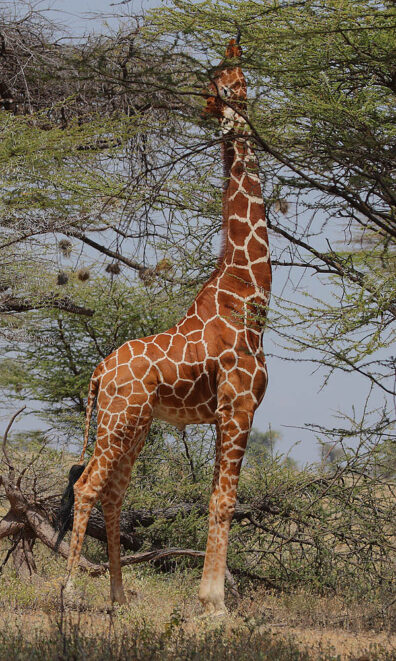
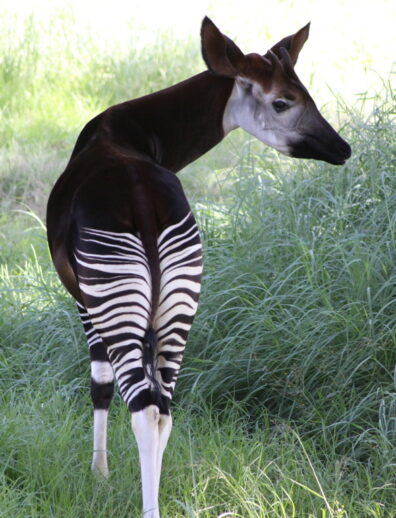
This giraffe (left) uses its purple prehensile tongue to harvest leaves from treetops. Its closest living relative, the okapi (right), has a purple tongue, too. Steve Garvie CC BY-SA 2.0, derekkeats CC BY-SA 2.0

_2009-04-04_04.jpg)
Skin is layers of mostly skin cells. Like nearly all our cells, skin cells have a nucleus full of DNA. That DNA tells the cell how to make proteins. You need all kinds of proteins to build your body and make it work. So, every cell needs a perfect copy of that DNA—without mistakes.
But UV light from the sun can mess up DNA. That’s where melanin comes in. It protects the DNA in skin cells from that damage.
Melanin-making cells are scattered through the layers of skin cells. There’s usually one melanin-making cell for every 40 skin cells. The melanin-making cells have finger-like extensions that reach out to contact all the skin cells nearby.
When the sun shines on skin, the UV light activates those melanin-making cells. They start churning out sacks of melanin—also called melanosomes. Then they reach out to the skin cells they touch and move sacks of melanin over there.
The goal is to safeguard the DNA.
“When we get exposed to the sun, a lot of those melanosomes move around to protect the nucleus,” Cooper said. “They hover above the nucleus to protect it from DNA damage. Sometimes I’ll say it’s like a flying saucer up above the nucleus.”
Or you can picture it like an umbrella. The melanin-making cells open up to block the DNA from the sun.
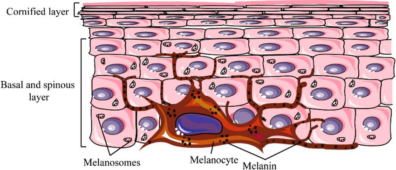
Each pink skin cell has a purple nucleus full of DNA. The melanin-making cell (melanocyte) moves sacks of melanin (melanosomes) to individual skin cells. D’Mello et al. 2016 CC BY 4.0
When those sacks of melanin move into a skin cell, the melanin pigment makes the cell darker. That’s how skin gets browner in the sun.
That works so well to protect DNA that humans living in places with lots of sun adapted to better protect their skin.
“Someone who lives near the equator needs a lot more protection than someone who lives near one of the poles,” Cooper said. “So, genetic changes led people to have different skin tones.”
And that’s probably why giraffes have purple tongues.
The ancestors of giraffes adapted to live in places with lots of sun. Plus, today’s giraffes are the tallest living land animals. They spend about 12 hours every day chomping on leaves at the tops of trees. They grab those leaves with a purple prehensile tongue. It can grab leaves like a slimy, muscular tentacle.
That melanin-packed tongue protects the DNA in the tongue’s skin cells.
I guess you could say giraffes really lick the problem of UV damage.
Sincerely,
Dr. Universe