Dear Tim,
I love to bake and eat depression cake. It was invented during the Great Depression in the 1930s, when some cake ingredients—like eggs, milk and butter—were hard to get.
The recipe makes fluffy cake because of a chemical reaction between baking soda and vinegar.
I asked my friend Mary Fennimore about chemical reactions. She teaches chemistry at Washington State University.
She told me that a chemical reaction happens when one or more substances—called reactants—undergo a change. They rearrange their atoms. That forms one or more new substances—called products.
It’s written like this. The arrow shows a chemical change happened.
reactants → products
Sometimes it’s hard to see that a chemical reaction has happened. Other times, it’s super obvious. It might change color or give off heat or release gas bubbles.
Those gas bubbles are the reason my cake rises.
“When we bake a cake, we put baking soda or baking powder in it,” Fennimore said. “That reacts with moisture and heat and forms carbon dioxide gas. The gas makes bubbles in the cake—and makes our cake light and fluffy.”
In depression cake, the baking soda reacts with vinegar.
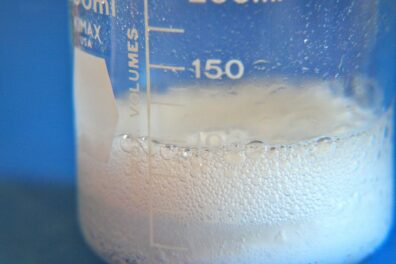
If you mix baking soda and vinegar, the chemical reactions make carbon dioxide bubbles. That works because baking soda is a base. It reacts with vinegar because that’s an acid. Baking powder contains a base and an acid. The chemical reaction kicks off when the baking powder mixes with wet ingredients. katerha CC BY 2.0

Baking soda’s chemical formula is NaHCO3. That’s a chemical compound. It’s made of six atoms bonded together. Those atoms are one sodium (Na), one hydrogen (H), one carbon (C) and three oxygens (O). Vinegar’s chemical formula is C2H4O2.
Inside the cake, two chemical reactions take place. First the bonds between all those atoms break. Then new bonds form between different atoms. That makes new chemical compounds.
You can write the first chemical reaction like this.
NaHCO3 + C2H4O2 → NaC2H3O2 + H2CO3
If you count, you’ll see the same numbers of atoms on each side of the arrow. They just rearranged which atoms were bonded together.
The first product—NaC2H3O2—sticks around in my cake. It makes it salty and keeps out mold.
The second product—H2CO3—undergoes another chemical reaction. It’s unstable, so it falls apart. Like this:
H2CO3 → H2O + CO2
The products on the right side of that reaction are water (H2O) and carbon dioxide (CO2) bubbles. They make my cake moist and fluffy.

Here’s one way to picture how this chemical reaction happens. You can see the vinegar (acetic acid) and baking soda (sodium bicarbonate) on the left side. Then the atoms rearrange into the products on the right. All those atoms are still there—just in different places. ©ACS
Fennimore told me that chemical reactions happen in nature all the time.
Chemical reactions are why fruit rots or breaks down in our stomachs. They’re why some metals rust if left out in the rain. Chemical reactions happen when we burn wax or wood and when plants make sugar during photosynthesis. They’re behind the scenes helping soap wash grime off your hands.
Whether or not a chemical reaction happens depends on what molecules or compounds are hanging around and how likely they are to react.
And those reactions aren’t all the same. Some go one way—with reactants forming stable products. Some go back and forth—forming and unforming products.
It’s complicated.
That’s why scientists sort molecules by their functional groups. That helps them see patterns in how atoms are arranged, how reactive they are, and what kinds of chemical reactions they participate in.
It’s like a chemis-tree of relationships that help us better understand our world.
Sincerely,
Dr. Universe