Dear Opemipo,
We usually think of adult butterflies. Those fluttery insects flit from flower to flower. They sip nectar and move pollen. They’re beneficial insects. They help plants and people.
But baby butterflies are another story.
I talked about it with my friend Dowen Jocson. She’s an insect scientist at Washington State University.
Young butterflies or moths are larvae, or caterpillars. They hatch from an egg deposited near a plant. Then they get busy eating and growing.
Caterpillars have jaws adapted for chewing. Their munchy mouths will change when they transform into adult butterflies. Then, they’ll have a straw-like mouth for slurping up nectar. Nectar doesn’t have much protein. So, caterpillars eat a ton, so they can grow and store protein. They’ll use that stored protein to make eggs when they grow up.
Caterpillars do all that feasting in one spot.
“They don’t have wings, so the larvae are going to eat as much as they can in one place,” Jocson said. “And that’s what makes them pests—especially on farms where their favorite food is all over like a buffet.”
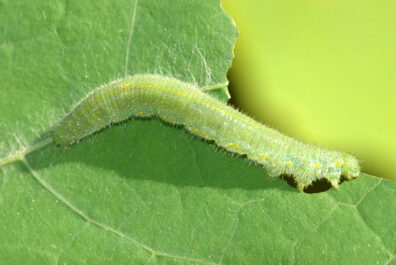
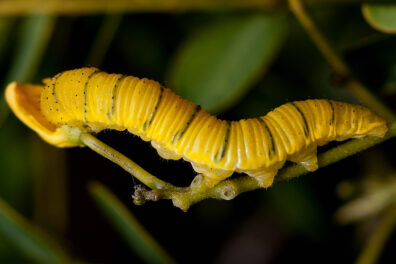
These are some common butterfly pests. Cabbage white caterpillars (left) eat cabbage, broccoli and cauliflower. Sulfur butterfly larvae (right) eat alfalfa, clover and beans. ©James Lindsey CC BY-SA 3.0 ©Andy Mansker CC BY-SA 3.0


Agricultural pests like caterpillars damage crops and make plants sick. There are a few ways to deal with them.
The first are cultural practices like crop rotation. If you regularly move the crops, the caterpillars might not hatch near their food. Fewer caterpillars mean less damage—and fewer babies the next year.
Chemical pesticides are another way to manage pests and protect crops. Some kill caterpillars. Some stop caterpillars from transforming into adults.
Then there’s bacteria called Bacillus thuringiensis, or Bt. It makes super sharp proteins. If a hungry caterpillar eats some of those bacteria, those poky proteins damage its gut. That’s fatal for caterpillars.
Sometimes farmers sprinkle or spray Bt on plants—like a pesticide. Sometimes scientists add a chunk of Bt DNA to the DNA in plant seeds. Then those plants make the caterpillar-killing proteins on their own.
But the coolest and grossest option is to make insects fight it out.
“Biocontrol is when we use the caterpillars’ natural predators to attack them in nature,” Jocson said. “We think about these farms as buffets for caterpillars. But they can also be a buffet for predatory wasps.”
There are gobs of predatory wasps out there. They’re beneficial insects because they help keep pests in check. You can even buy and release wasps that fight caterpillars.
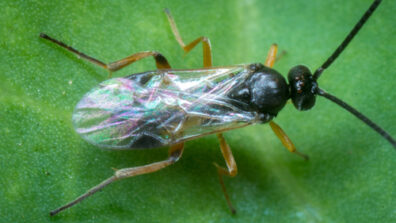
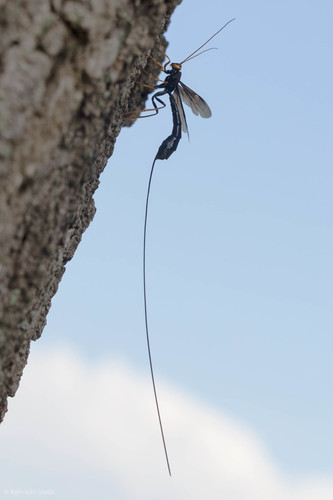
Predatory wasps that lay eggs inside or on another insect are called parasitoid wasps. They’re probably the most diverse group of insects on the planet. There’s a parasitoid wasp that preys on every other kind of insect. Most are tiny and hang out near flowers. They don’t usually bite or sting people. If you see one with a super long “stinger,” that’s actually a tool for laying eggs and can’t hurt you. © David Cappaert CC BY-NC © Ken-ichi Ueda CC BY-NC
Some predatory wasps do that in a super gnarly way.
They lay eggs inside another insect’s body—like a very hungry caterpillar. The eggs hatch, and the wasp larvae live inside the caterpillar, feasting on its guts. When they’re ready to become adults, the wasps chew through the caterpillar and spin cocoons. Then they transform and take off—leaving the dead or dying caterpillar behind.
Some wasps secrete or inject chemicals to take over the caterpillar’s brain. They force it to protect the baby wasps, even though they’re killing it.
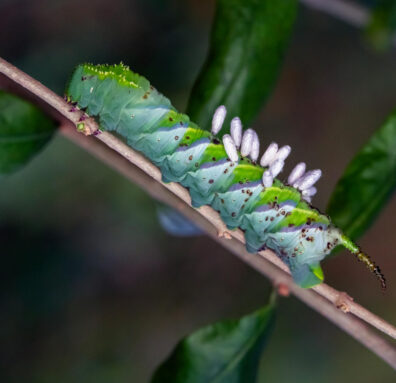
This is a hornworm caterpillar. It’s a pest because it eats tomato and other plants. It grows into a sphinx moth—unless a wasp gets to it first. The white cocoons contain wasps that are transforming into adults. If you see a caterpillar like this, it’s too late to save it. But you can help the beneficial wasps by leaving them alone to complete their life cycle. ©WanderingMogwai CC BY-SA 4.0

Since that caterpillar never makes it to adulthood, it doesn’t reproduce.
That means fewer pests to bug the crops—and farmers.
Sincerely,
Dr. Universe
P.S. If you’d like to watch baby wasps chew their way out of a cabbage white caterpillar and spin cocoons—and then see the caterpillar defend them, you can find a video here. It’s not for the squeamish!