Dear Alyssa,
Cats are carnivores, but I can never turn down a juicy apple.
I asked my friend Kate Evans about apple trees. She’s a plant biologist and apple breeder at Washington State University.
She told me that how many apples appear on a tree starts with the blossoms.
Every apple tree makes blossoms. Tucked inside the flower is the pollen-making part called the stamen. When a bee visits the apple blossom to slurp up nectar, it picks up some pollen there.
Then the bee zooms to another apple tree. Some pollen falls off. It lands in the sticky center of the flower—on the pollen-catching part called the pistil. The pollen forms a tube that grows down to the bottom of the pistil. There, it fuses with an ovule.
That makes an embryo inside a cute little package—an apple seed.
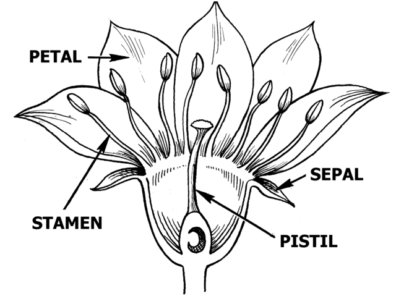
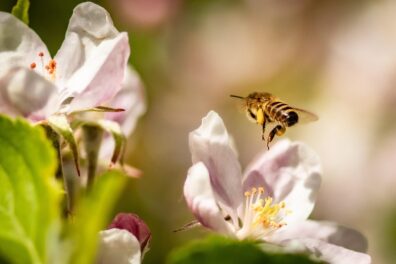
Bees pick up pollen from the tip of the stamen called the anthers. Then they drop some pollen on the sticky top of the pistil called the stigma. Apple trees aren’t self-fertile. So, the pollen comes from one tree and gets moved to a different tree. This bee is toting the pollen with hairy pollen-carrying structures on its back legs called corbiculae, or pollen baskets.
The ovary develops into the apple core. The seeds sit inside. The fleshy part of the apple that grows around the core is there for one reason—to be yummy. When a person or animal chows down on that tasty apple flesh, they spread the apple seeds by tossing them somewhere or pooping them out.
Sometimes bad weather causes problems for apple trees. If the tree blooms early or there’s a late freeze, the buds or flowers could freeze. They might not turn into apples after that. A big freeze can mean fewer apples. Or none at all.
Sometimes the apple tree makes itself bear less fruit. When an apple tree has apples, the buds for next year’s apples are already starting to form. The tree divides its energy between the growing apples and the forming buds—and the apples send the tree chemical messages that tell the tree to make fewer buds and focus on the fruit.
A tree with gobs of apples will get lots of those messages. It will put less energy into the buds. Fewer buds means fewer apples the next year. So, some trees make bunches of apples one year then hardly any the next year. It’s called biennial bearing—and that’s bad news for growers who rely on a steady crop of right-sized apples.
That’s why people thin their trees.
“Growers manage the crop load by taking off extra flowers and extra fruitlets to try and get a better quality crop as well as return bloom and return fruit the next year,” Evans said.
But the biggest reason your apple tree might not make apples has to do with DNA.
If you test the DNA of an apple and its seeds, the apple matches the tree it grew on. But every apple seed is a genetic mix of its parents.
“Each seed is a combination of the tree it’s grown on and the pollen source,” Evans said. “So, every seed is as similar as you would be to your siblings, if you have the same two parents.”
To get an apple full of seeds, you need two apple trees. They must be different and compatible. Some apple tree genes work together. Some don’t.
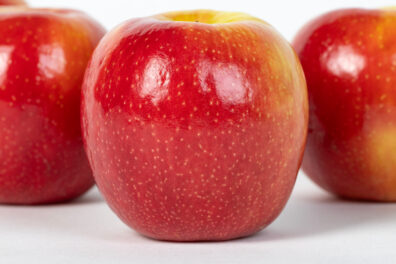
Evans and the WSU apple breeding team made a new kind of apple—the Sunflare™—by pollinating Honeycrisp flowers with Cripps Pink (Pink Lady) pollen. You should be able to scoop it up at a grocery store in 2029. Until then, you can taste another of her apples, the Cosmic Crisp®. It was made by pollinating Enterprise flowers with Honeycrisp pollen. ©2024 Washington State University
So, if your apple tree doesn’t make apples, there might not be a compatible apple tree nearby. You may need to be a bee yourself—and go move some pollen.
“If your tree has bloomed consistently, but you’ve never had any apples, go find another apple tree,” Evans suggested. “Ask nicely if you can take some of the flowers. Then dust the flowers over your tree and see if they set fruit.”
If the pollen is compatible with your tree, you might wind up with fruit that’s apple-solutely un-core-gettable.
Sincerely,
Dr. Universe