Dear Wrigley,
It can be hard to relate to animals that look very different from me—like squirmy worms.
I asked my friend Cynthia Gleason about your question. She studies a specific kind of worm at Washington State University.
Those worms are called nematodes or roundworms. They have unsegmented, smooth bodies. Most nematodes are so small you need a microscope to see them—and their teeny tiny mouths.
There are gobs of nematodes.
“They’re the most abundant of all the multicellular organisms on Earth,” Gleason said. “If you pick up a handful of soil, there could be thousands of roundworms there.”
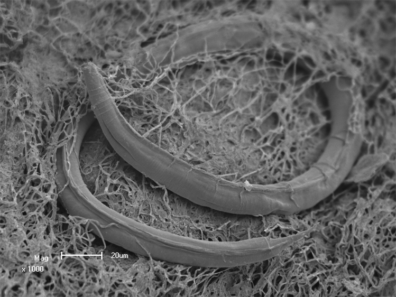
Scientists found this nematode dormant in water nearly a mile below the surface of the Earth. The nematodes woke up in the lab. Some scientists wonder if microscopic animals like these could live under the surface of Mars, too. Borgonie et al. CC 4.0
Some nematodes are beneficial and free-living. They’re helpers and live on their own. They roam around looking for meals. Some eat bacteria and other microscopic organisms. Other nematodes eat fungi, decaying matter and algae. Some even eat other nematodes.
A nematode’s mouth is adapted to what it eats.
Roundworms that chow down on bacteria have big, open mouths. They may have mouth parts that stick out and sweep tasty morsels inside.
Nematodes that eat fungi use delicate, needle-like mouths called stylets. They pierce the fungus and slurp up what’s inside.
Nematodes that prey on other roundworms can have teeth. They chew holes in their prey and eat the insides.
When free-living nematodes eat, they boost their ecosystems. As they gobble up bacteria or fungi, they release nutrients that plants use—like nitrogen. They also speed up the breakdown of organic matter and keep other organisms in check.
But not all nematodes are helpers.
Parasitic nematodes don’t live on their own. They live on or inside what they feed on. That could be animals or plants.
“I work on plant parasitic nematodes—and these are the ‘bad guys’ in the soil ecosystem,” Gleason said.
These nematodes have mouths with stylets, too. But theirs may be stronger and hollow. They use it to stab into plant cells and vacuum out the contents.
All nematodes have a muscular organ called a pharynx. It pumps food from the mouth to the intestine. Nematodes don’t have a stomach. But they do have an anus for expelling waste.
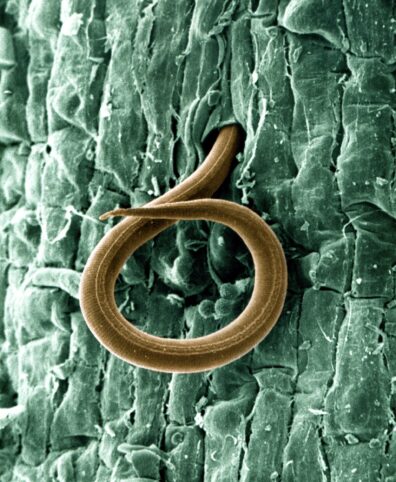
Gleason studies parasites like this root-knot nematode. This one sucks the nutrients out of tomato plants. William Wergi/Richard Sayre/USDA-ARS, colorized by Stephen Ausmus CC BY 2.0
_penetrates_a_tomato_root_-_USDA-ARS.jpg)
Nematodes aren’t the only kind of worm.
Earthworms are the big, wiggly worms you find in gardens or on a fishing hook. The tip of an earthworm’s front end has a mouth and sensory parts. That’s how it finds food. Then it slurps bacteria, fungi and decaying matter into its mouth. The earthworm sends that through its digestive tract and excretes the waste.
That excrement—called castings—is great for soil.
Then there are flatworms. Most of these worms have a mouth but no anus. That mouth is about midway down the body. Since they can’t poop, they use their mouths to eat and barf up solid waste.
Maybe the most relatable thing about those worms is how they dig multitasking.
Sincerely,
Dr. Universe