Dear Garrett,
On very clear days, I can see five volcanoes from my campus. They’re Rainier, Hood, Adams, St. Helens and Baker. That’s…a lot.
I asked my friend Katie Cooper about it. She’s a geophysicist at Washington State University.
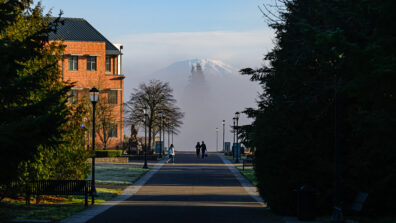
Check out the view of Mt. St. Helens from the Vancouver campus. This volcano erupted in 1980. It was one of the most destructive volcano eruptions in the US. ©WSU
She told me we don’t know precisely how many active volcanoes there are at this moment on the Earth. That’s because some of them are tough to count.
“The volcanoes that stick up above water are a lot easier to count because you can see them,” Cooper said. “But the ones underwater are harder to find. We haven’t mapped out or explored all the ocean floor, which is 70% of our planet’s surface.”
Scientists think there are about 1,350 potentially active volcanoes in the world. That’s not counting some of the ones on the ocean floor. About 500 of those have erupted since humans started keeping records.
Lots of those volcanoes are in the Pacific Rim. That’s also called the Ring of Fire. It’s a big horseshoe-shaped area. It goes up the western coasts of South America and North America, across the Pacific Ocean, then down the side of Japan and New Zealand.
The Pacific Northwest is in the Ring of Fire. That’s why I can see so many volcanoes.


This is the Ring of Fire. North America and South America are the continents on the right in this map. The blue lines show trenches. Those are places where one tectonic plate pushes under another one. That process makes volcanoes nearby.
It’s a lot trickier to count volcanoes under the oceans. Plus, many of those volcanoes are different from what we usually imagine.
Most people picture a volcano as a mountain. It forms when tectonic plates bash into each other or slide under each other. That motion shoves the crust up into that mountain-like form. Inside, magma bubbles up through Earth’s crust toward the surface. When it erupts, magma oozes, spurts or explodes out to the surface. Once it’s out, we call it lava.
But underwater volcanoes can happen when tectonic plates on the sea floor pull apart.
“We have a large amount of volcanoes underneath the ocean floor,” Cooper said. “They’re these long, linear chains called mid-ocean ridges. That’s where two plates are coming apart. Moving away from each other causes melting to happen in the middle. And so, the ridge itself is a volcano. But a very different type of volcano than we like to imagine.”
To count volcanoes above water, scientists look for evidence of past eruptions. They use instruments to see the magma chamber under the volcano.
To count volcanoes underwater, scientists would need to map the whole ocean floor. Cooper told me that there are little bits of iron in some volcanic rocks. When these rocks are erupted, the iron bits within them lines up with the Earth’s magnetic field. They point north—just like a compass.
But the North Pole and South Pole sometimes switch—and nobody is sure exactly how that works.
Since the iron in the volcanic rocks lines up with the poles, the ocean floor has magnetic stripes. They tell scientists which pole was the North Pole when the plates spread apart in that spot.
Learning more about the ocean floor could help us understand all kinds of things. Like how and why the poles flip and how many volcanoes are underwater.
It could be explosive knowledge.
Sincerely,
Dr. Universe