Dear Isana,
My belly button is a subtle scar on my tummy. It’s covered by fluffy cat fur—and it’s not easy to see. But humans have obvious belly buttons. They come in different sizes and shapes.
I asked my friend Cindy Brigham-Althoff about that. She’s a nurse midwife and professor at Washington State University. She teaches student nurses about birth.
She told me the scientific name for a belly button is umbilicus. It’s what’s left of your umbilical cord.
Before you were born, a temporary organ called the placenta grew next to you. A cord connected the placenta to a spot in the center of your developing tummy. Oxygen and nutrients traveled in blood from the placenta and down the umbilical cord to your body. Waste left your body and flowed the other direction.
After you—and your placenta—were born, a midwife or doctor placed two clamps on your umbilical cord. They used special scissors to snip the cord between the clamps. That separated you from your placenta.
“The umbilical cord has no sensation,” Brigham-Althoff said. “So, babies don’t feel when the cord is clamped and cut.”
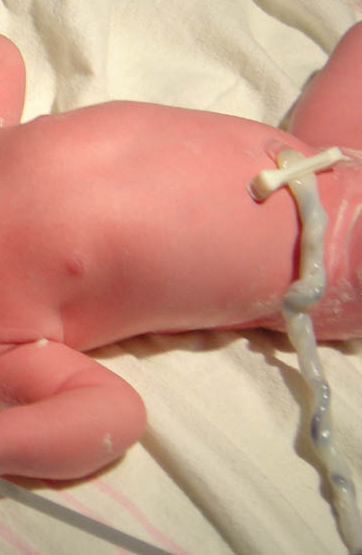
This is what a newborn baby’s clamped umbilical cord looks like before it’s cut. Some people don’t cut the umbilical cord. They leave the placenta attached until it naturally separates. Wild mammals usually bite through their babies’ umbilical cords with their teeth.
What’s left is a small, meaty stump.
Some newborn babies need medicine or fluids delivered by an IV. Sometimes they can receive that through their stump, so they don’t feel a needle poke at all.
Within a few weeks, your stump dried up and fell off. It left behind a scar—your belly button!
Brigham-Althoff told me that process has nothing to do with the size or shape of your navel. How it looks at the start is a total wild card.
But your belly button probably won’t look the same for your whole life.
As people grow and get older, they may add fat tissue to their abdomens. That makes the belly button appear bigger or deeper. It can even change its shape. That’s why an outie belly button—where some of the umbilical scar tissue pokes out instead of dipping in—is super uncommon among adults.
All mammals with placentas wind up with an umbilicus. It’s a remnant of life inside the womb. It’s a reminder that we have a lot in common with our mammal relatives.
Who are all as cute as a (belly) button.
Sincerely,
Dr. Universe