Dear Penny,
Blue oceans, green forests, a cozy blanket of oxygen. Our planet is a super comfy home. It’s hard to imagine there was ever a time it didn’t exist.
I asked my friend Julie Ménard how Earth formed. She’s a planetary scientist at Washington State University.
She told me it started with the Big Bang. That was nearly 14 billion years ago.
“The Big Bang is not an explosion,” Ménard said. “It’s an expansion. Everything in our universe today was in a tiny spot—smaller than the eye can see. Eventually, the pressure and density got so high that it started to expand.”
That expansion is why our universe has space, time, energy and matter.
At first, the universe was like a hot stew. Instead of carrots and potatoes, it had particles. As the soupy universe cooled, particles collided to make atoms and elements. Lumps of gas came together until they were super heavy. They collapsed into fiery stars.
About 4.6 billion years ago, a star exploded near where our solar system is now. That explosion caused a shockwave that sent a nearby cloud of dust and gas spinning.
Most of the stuff in the spinning cloud rushed to the center of the cloud. It formed a protostar—our baby Sun. As it spun around the baby Sun, the cloud flattened into a disc. It spun faster and faster.
Bits of dust and gas in the disc started bumping into each other. They clumped together into bigger bits. That bumping and clumping is called accretion.
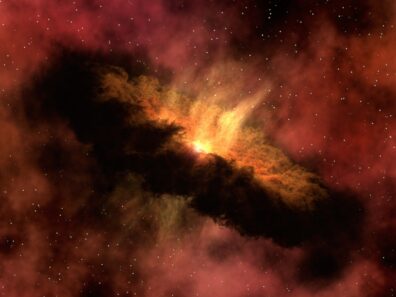
An artist made this to show what a dusty accretion disc around a protostar looks like. Accretion happens in our homes, too. Have you ever seen a dust bunny under your bed? That forms when dust and debris in your house bumps and clumps together—AKA accretion. NASA
Little by little, bits of dust and gas banged together until planetesimals formed. Those itty-bitty planet builders were about the size of a few city blocks. They were big enough to have their own gravity. That gravity pulled and pushed different planetesimals toward each other. They bashed together and formed protoplanets—sometimes called baby planets.
Then those protoplanets collided and formed planets—like our Earth.
“With each of those impacts, there’s a little more heat that is added to it,” Ménard said. “So, when the planet first formed, it was a ball of lava. It was molten.”
For about a billion years after it formed, Earth was super-hot. Plus, tons of comets and asteroids collided with it. It was very different from the planet we know.
Eventually, things cooled and settled down. Earth slowly changed into the cozy, life-supporting home it is now.
You could say it was a stellar improvement.
Sincerely,
Dr. Universe