Dear Nora,
I live near a few volcanoes. One of them—Mount St. Helens—is bubbling with molten material that will probably gush out as lava someday.
I asked my friend Johannes Hämmerli about lava. He’s an earth scientist at Washington State University.
He told me Earth is mostly solid.
“The very center of Earth is a solid metal ball,” Hämmerli said. “Outside that ball, there’s a thick shell we think is liquid. And the rest of Earth—if you go through the mantle and crust—is pretty much solid.”
Earth formed when a cloud of dust in space collapsed. The elements inside the cloud squished together. As it squished, it got hotter and melted. Heavy stuff like iron and nickel sank to the middle. That formed the metal core. It’s now solid because it’s under so much pressure.
That metal ball sits inside a big bubble of liquid called the outer core. It’s made of similar stuff, but it’s under much less pressure. It’s not being squeezed as much, so it flows like any liquid.
That’s super important for life on Earth.
The metal atoms in the liquid outer core swirl around in the super-hot metal syrup. That churning makes a magnetic field around Earth. It works like an invisible shield, deflecting dangerous radiation from the sun.
The liquid outer core is surrounded by the thick layer called the mantle. It’s mostly solid rock—not melted like lava. Over time, changes in heat and pressure make the solid rock slowly flow. It’s like how taffy is solid but stretches and oozes in a way most solids don’t.

Solids that flow are non-Newtonian fluids. That’s why taffy stretches and flows when it’s pulled. It’s also why glaciers move (super slowly). Chan et al. CC BY 4.0
On top of the mantle is Earth’s outer layer, also known as the crust. That’s the solid ground we walk on.
Most of the mantle is solid rock. But sometimes parts of the mantle melt and turn into liquid rock. That can happen if the mantle gets hotter or water seeps in. Or it can happen if the pressure decreases. Liquid rock underground is called magma.
That melted rock slowly rises toward the surface—because it’s less dense than the solid rock. If it erupts from a volcano, the liquid rock is called lava.
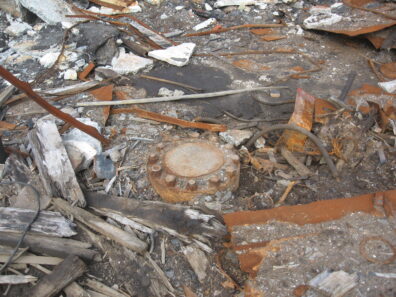
The deepest hole ever dug is the Kola superdeep borehole in Russia. Scientists gave up on that project in 1995. Now it’s just a metal cap in rubble. Rakot13 CC BY-SA 3.0
,_%D0%B0%D0%B2%D0%B3%D1%83%D1%81%D1%82_2012.JPG)
Hämmerli told me that nobody has ever reached Earth’s liquid outer core. It’s about 1,800 miles below the surface. That’s the distance from Los Angeles to Chicago—nearly a 30-hour car ride.
Humans have only drilled about 7.5 miles into the Earth. There’s just so much heat and pressure down there. That makes the drills fail or gum up. It would be super expensive to overcome those challenges.
So, how did we figure out there’s a liquid outer core if we can’t stick a straw down there and slurp up a sample?
It turns out we got clues from earthquakes. They send out two kinds of waves. Some waves can travel all the way through Earth. Other waves can’t do that. They come to a screeching halt when they bump into liquid—like the outer core.
That and other data point toward how we understand Earth’s layers today.

Scientists used to think Earth’s core was all liquid. That changed thanks to Danish geophysicist Inge Lehmann. Her 1936 scientific paper showed that Earth has a solid core surrounded by liquid.
Maybe someday we’ll drill deeper to volca-know even more about Earth’s interior. That would really rock.
Sincerely,
Dr. Universe