Dear Kenton,
When I think about the Arctic, I picture frigid waters filled with narwhals, polar bears and icebergs.
I asked my friend Von Walden how those icebergs got there. He’s a polar scientist at Washington State University.
He told me a glacier is a huge mass of ice on land. But glaciers don’t just sit there. They move. A glacier is like a slow-moving river of ice. It’s made of heavy, compacted snow. It flows over the land because of its own weight.
An iceberg is a broken-off piece of a glacier.
To be an iceberg, that broken-off chunk must be about twice the size of a house. A mini-iceberg—about the size of a piano—is called a growler. Ice chunks in between those sizes are called bergy bits.
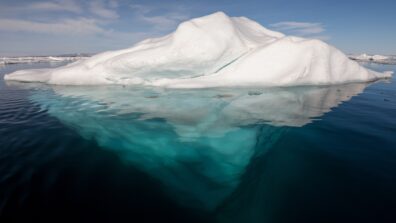
When the sea is calm and clear, you might be able to see the bottom of an iceberg underwater. About 90% of an iceberg is below the water. That’s why we say something is “the tip of the iceberg.” It means that we’re only aware of a little bit of a situation—because there are more details we can’t see. AWeith CC BY-SA 4.0

“Imagine you have a glacier that’s sitting in a valley—and at the end of that valley is a lake,” Walden said. “A piece of the glacier at the end may break off. Then it’s no longer held to the glacier, so it can float around in the lake.”
Or an iceberg may break off a glacier by the ocean. That iceberg probably falls into the ocean.
Once the iceberg plops off a glacier and into water, it floats around like an ice cube in a drink. The solid iceberg is less dense than the liquid salt water—so it stays on top of the water.
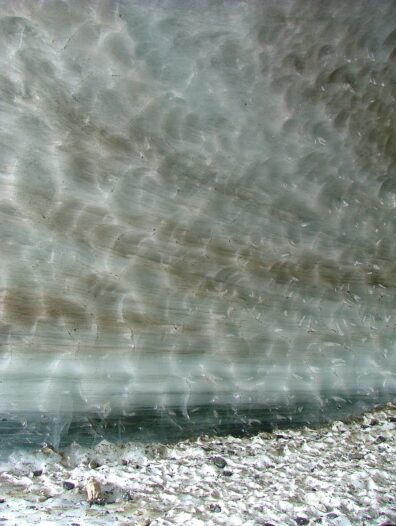

Glaciers are non-Newtonian fluids. They’re solid but they flow. Some of that flow comes from a band of melty, slippery ice at the bottom of the glacier (left). Taffy is another non-Newtonian fluid. If you stretch it, it doesn’t stay still. It oozes and flows under its own weight. Smith609 CC BY 3.0, Chan et al. CC BY 4.0

When a chunk of ice breaks off a glacier, that’s called calving. That can happen if the glacier gets warm or some other force makes a piece split off. The end of the glacier—where the iceberg slides off—is called the terminus.
Sometimes glaciers move slowly. But sometimes they move super-fast—like half a mile a day. That might happen in the summer when it’s a little bit warmer. The bottom of the glacier may melt a little. That makes the ground under the glacier slippery, so the glacier can move quickly. That’s called a glacial surge.
“If you have a glacier that’s terminating at an ocean, and that glacier surges, it’s going to shove all that water out over the ocean,” Walden said. “For a while, there will be a big tongue of ice out over the ocean. And then—pfft—it just breaks up. It disintegrates into hundreds of icebergs.”
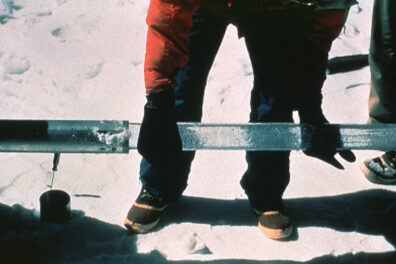
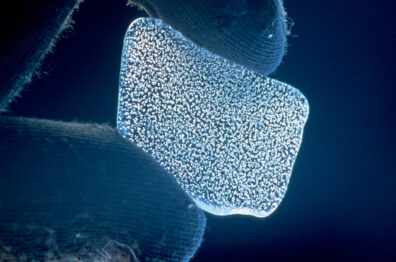
Scientists like Walden study polar ice by drilling deep into a glacier or other ice. Then they pull out a long, tube-shaped core sample. The ice is full of trapped air. Studying that air helps us understand Earth’s past. Walden told me he ate an ice chip from an ice core. It was 750,000 years old! He said those little air pockets made the ice pop in his mouth. Lonnie Thompson, CSIRO CC BY 3.0


The cool thing about icebergs is that they’re always fresh water—even when they’re floating in the salty ocean. Both glaciers and icebergs are part of Earth’s water cycle. Some of their water will naturally wisp off as water vapor. It will float up into the atmosphere and form clouds. When those clouds slip over the mountains—which are high and cold—some of the water will fall as snow.
It could wind up back on the top of a glacier, adding to its mass and helping it flow n-icely.
Sincerely,
Dr. Universe