Dear Penelope,
I love the feel of freshly fallen, fluffy snow. But then it turns crunchy and wet. That feels yucky under my paws.
I asked my friend Jaitun Patel why that happens. She’s a data scientist at Washington State University’s AgWeatherNet. She makes sure weather stations put out reliable data.
She told me that fluffy snow turns crunchy because of how falling snowflakes land then melt and refreeze.
Snow forms when water vapor freezes way up in the clouds. That makes ice crystals called snowflakes.
Snowflakes look different depending on the conditions when they form. Some look star-shaped. They have lacy or fern-like arms that stick out. Others are flatter or have plate-like arms.
No matter how they look, all snowflakes have six sides or points.
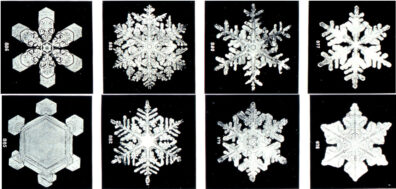
A farmer named Wilson Bentley took these photos in 1902. Each snowflake has a different shape—but they all have six sides. ©NOAA
When snowflakes fall, they land in different positions. One might land on its arm. Another might land on its flat part. If you look closely at a pile of fresh snow, you’ll see snowflakes frozen in a loosely packed jumble.
There’s lots of empty space in that haphazard pile of snowflakes.
“Fresh snow is more like a pile of feathers,” Patel said. “There are many air pockets between the snowflakes—and that’s why the snow’s so fluffy and soft.”
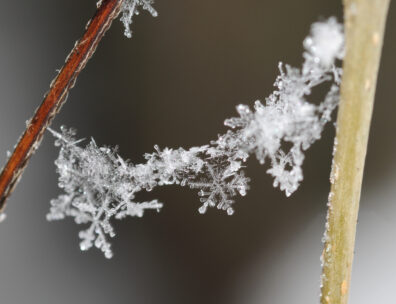
When snow falls, it lands in different positions—even when it doesn’t land on the ground like these. You can see lots of space between these snowflakes. ©Thomas Bresson CC BY 2.0
.jpg)
When you walk on fluffy snow, it probably sounds swooshy or squeaky.
But then the sun comes out.
The sun’s warmth melts the top layer of fluffy snow. That makes liquid water that oozes into the air pockets between the snowflakes in the deeper layers of snow.
If the temperature drops again—like when the sun goes down—the snow refreezes. The liquid water between snowflakes freezes, too. Now the snow is dense and packed together. The air pockets are full of ice.
“Imagine you have a glass of crushed ice,” Patel said. “Then you pour in some water to fill the spaces between ice cubes. If you refreeze it, it makes a block of ice. That’s what happens outside, too.”
Outside, the snow can melt and refreeze over and over as the daily temperatures rise and fall. Each time it freezes, the ice becomes denser. That can make a thick layer of ice.
When you walk on that ice, it’s slippery and brittle. The ice crystals break and rub together. That makes a crunchy sound. The level of crunch depends on how cold it is. At lower temps, the ice crystal are harder and more brittle, which means crunchier snow.
As you walk, your steps create pressure and a tiny bit of heat. That—plus the sun’s warmth—melts the snow even more. It becomes less crisp and more sloshy.
You could say that, after a fresh snowfall, the texture is a slippery slope—from fluffy to crunchy to mushy to…gone.
Sincerely,
Dr. Universe