Dear Lahna,
Your question made me think about how words change. The dictionary adds new words and definitions all the time.
The latest update to the Oxford English Dictionary added jelly, meaning jealous. It also included drop bear. That’s an imaginary scary-koala that appears in stories.
I asked my friend Nikolaus Overtoom how we got the abbreviation for ounces. He’s a professor of ancient history at Washington State University.
It turns out ounces—and later oz—evolved as words traveled from Ancient Rome through Medieval Europe and into England.
“The mixture of linguistic elements in English makes it one of the most flexible, diverse and complex languages in history,” Overtoom said. “It is a language that continues to evolve and grow to this day, with each generation creating and adopting new English words.”
Like doomscrolling. That word also made it into the dictionary this year.
The story of oz starts with ounces.
Before the Ancient Romans started using coins, they carried lumps or bricks of bronze. It was like money—but super heavy. If you had to a pay a big bill, you might need a wooden cart to tote your payment.
Eventually, the Romans wanted to standardize these bronze chunks. They made aes grave, the first coins in Rome. These were still pretty heavy. Each coin weighed one Roman pound, or libra. A Roman pound was 12 ounces.
But sometimes people needed to weigh or pay smaller amounts. So, they came up with a unit that was 1/12 of a Roman pound—an uncia.
Since uncia just means 1/12, it’s also how people measured lengths shorter than a Roman foot. That’s how we got the English word inch.
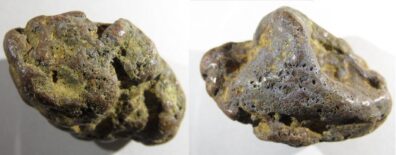
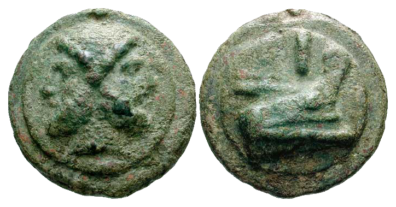
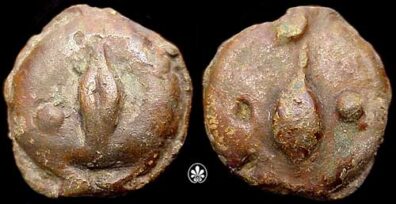
Lumps of bronze were called aes rude (top). This version of the first coin, Aes grave, is called an as (middle). Uncia coins (bottom) were worth 1/12 the value of these. But Romans didn’t invent the first coins ever. Those probably came from Lydia, an ancient kingdom in what’s now Turkey. Chuy 1530 CC BY SA 3.0. Classical Numismatic Group CC BY 3.0
As time went on, regular people stopped speaking formal Latin. It evolved into new languages—like French, Spanish and Italian. When the Normans (medieval French descendants of the Vikings) took over England, they brought French words. One of these was unce, from the Latin uncia. That changed into the English word ounce.
Back in medieval Italy, merchants used the Italian version of the word: onza. Sometimes they shortened it to oz.
As people traded with each other, oz traveled to England.
There were other changes, too. You might have clocked that a Roman pound isn’t the same pound we use today.
That’s because we use a wool pound, or Avoirdupois. That pound is the same as 7,000 grains of barley, or 16 ounces. English wool traders changed it because the number 16 was practical. It can be halved four times to weigh or sell smaller amounts.
A Roman pound is the same as 5,000 grains of barley, or 12 ounces. People who sell precious metals and gems today still use a variation of this—the Troy pound (5,760 grains).
But that original Roman pound—libra—is why we use the abbreviation lb.
It seems weird since neither of those letters show up in the word pound. But if you track how the words changed over time, it makes an ounce of sense.
Sincerely,
Dr. Universe