Dear Gwen,
I’m a short-haired cat. So, it’s easy to keep my fur sleek. My long-haired roommate licks his fur all the time to keep it tangle-free.
I asked my friend Ryan Driskell about those tangles. He’s a cell biologist at Washington State University. He studies skin and hair.
He told me that if you zoom in on a single strand of hair, the surface looks rough. It’s made of overlapping scales—called the cuticle. You can picture it like the overlapping scales on a fish’s body or the seed scales on a pine cone.
The hair you can see pokes out of a pore in your skin. But a hair starts under your skin at the hair bulb.
Blood vessels feed oxygen and nutrients to the hair bulb—because it’s alive. The cells in the hair bulb divide super-fast. As they divide and add new cells at the base of the hair, the old cells get pushed up. That’s how your hair grows longer.
As the cells grow and move upward, they fill with a tough protein called keratin. They eventually die and become part of the hair shaft. Some form the cuticle.
Humans usually have 6 to 10 layers of cuticle scales on each hair—plus a thin protective coating of natural fats.
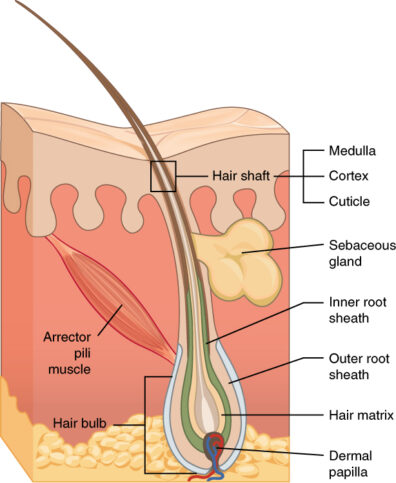
Here’s what a hair looks like under your skin. The dermal papilla contains the blood vessels that feed the hair bulb. OpenStax College CC BY 3.0

Just under your skin, sebaceous glands produce oil. It also covers your hair strands and protects them. It makes your hair soft and shiny.
But some hair has less of the cuticle’s natural protective coating. And this layer on each strand can wear away over time. Some people make less oil, too. Without as much protection, hair strands can rub against each other more easily.
“The microscopic outer protective layer of each strand—called the cuticle—becomes rough and lifted,” Driskell said. “It acts like tiny pieces of Velcro and sticks to each other.”
Hair strands naturally twist and twine together as your hair moves. When the cuticle of one strand rubs against another, any lifted edges can snag together. That makes it harder for the strands to slide apart. That’s a hair tangle.
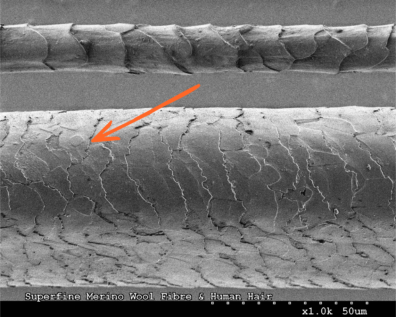
This is what a human hair looks like up-close. You can see the edges of the overlapping scales (arrow). If those stick up, they can catch on other hairs. The top strand is merino wool from a sheep. CSIRO CC BY 3.0, arrow by Dr. Universe

Some hair tangles up more easily. The twists of coily, curly or wavy hair may hook together.
Damage also increases tangling. The scales of damaged cuticle stick up and snag on other scales. That damage can come from chemicals like bleach or from too much heat styling or sun exposure. Harsh treatment also causes damage—like rubbing your hair too roughly with a towel.
You can minimize damage by avoiding those things and by using conditioner. That can help smooth your hair and reduce rubbing between strands.
I guess you could say babying your hair is a cuti-cool way to manage tangles.
Sincerely,
Dr. Universe