Dear Friend,
Right now, shafts of sunlight stream through my office window and glisten off my fur as I type. Later, I might stretch out in the garden and bask in the warmth.
I can’t imagine a world without the sun.
I asked my friend Michael Allen what it would be like. He’s an astronomer at Washington State University.
He told me the sun provides two things—gravity and light.
Gravity is the force that pulls objects toward each other. It anchors us to the Earth’s surface. It keeps the Earth in the sun’s orbit. It holds our whole solar system together.
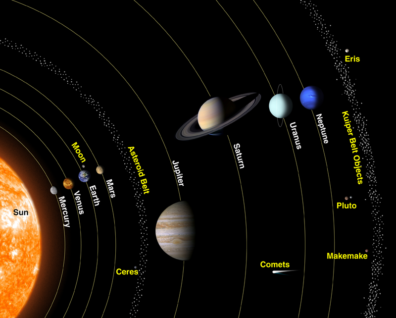
The Earth is 93 million miles away from the sun. It takes the sun’s light about 8 minutes and 20 seconds to reach us.
“So, if the sun were just plucked out of the solar system, the Earth would wander into interstellar space,” Allen said.
That wandering would start as a straight path. But the Earth wouldn’t keep going forever. It would make a very gentle curve as it slowly orbited the Milky Way. It would take us about 200 million years to travel around our galaxy.
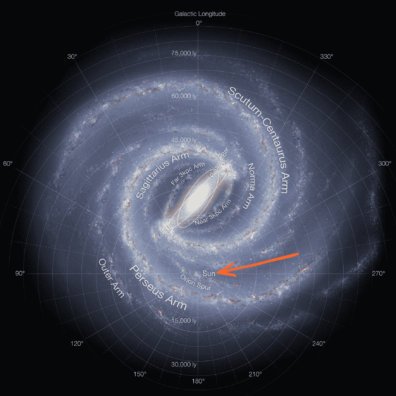
This is a model of our Milky Way galaxy. The sun (and all of us) sit where the orange arrow points. ©NASA-JPL, Caltech, ESO, Robert Hurt, arrow by Dr. Universe
The sun’s light makes it possible to see the world around us. It’s how nearly all food chains work. Plants use light to change carbon dioxide and water into sugar and oxygen.
And the sun’s light keeps us warm.
Without the sun, nearly all the remaining heat and energy would be what’s deep inside the Earth.
“Life on Earth wouldn’t be extinguished,” Allen said. “As human beings, we would probably have to tunnel down. And civilization, in a very contracted form, could certainly survive—probably for millions of years. But the ecosystem would be tough.”
After the sun disappeared, the atmosphere would freeze. All the gases in the air—the carbon dioxide, the oxygen, the nitrogen—would fall to the Earth’s surface like snow. Frozen gases would pile up several stories deep.
Allen told me that one science fiction writer—Fritz Leiber—imagined post-sun humans climbing up to the Earth’s surface to collect frozen oxygen. They needed buckets of air to breathe and keep underground fires burning.
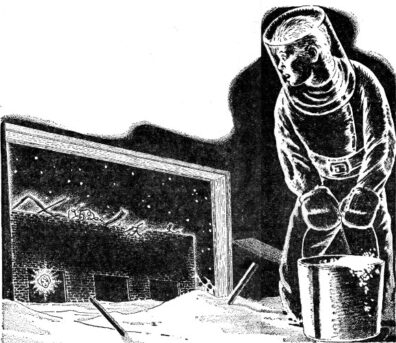
Fritz Leiber’s 1951 short story “A Pail of Air” spins what would happen if the Earth were captured by the gravity of a dark star. The main character’s chore is scooping up frozen air to bring down to his family in their underground home. Image: Ed Emshwiller, Galaxy Science Fiction, December 1951, via Project Gutenberg
It wouldn’t be a good time. And few species would fit in the cramped underground quarters. So, we would lose lots of plants and animals.
How the sun could disappear is speculative—just ideas.
A third object could show up and disrupt Earth’s orbit. That could be a passing star or a rogue planet. Or maybe our sun has a companion star that’s been far away but someday swings back through and bonks us.
Perhaps the sun could become dim or wink out. The sun has relatively cooler patches—called sunspots. Billions of those or one super huge sunspot could dim the sun.
Or, as the sun orbits the Milky Way, it could go through a dense dust cloud. That would probably dim its light—at least for a while. Eventually, the sun would burn off the dust or pass through the cloud.
And someday the sun will die—starting in about 5 billion years.
The sun makes light by smashing hydrogen together to form helium. Eventually, that will stop. The sun will expand into a red giant. It will engulf Mercury and Venus. It might swallow the Earth.
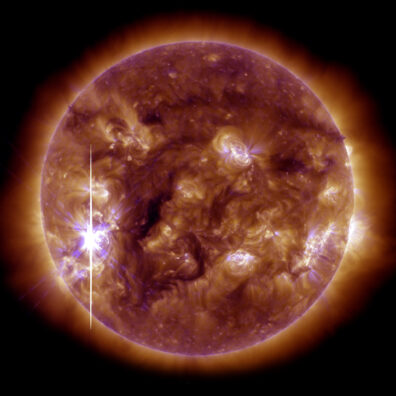
This is a photo of the sun’s surface taken from a NASA observatory. It’s about 10,000 degrees F on the sun’s surface—because of nuclear fusion. At sunspots, magnetic forces block some heat, so it’s a little bit cooler there (but still mega hot). Sometimes explosions called sun flares happen there. ©Scott Wiessinger, Solar Dynamics Observatory at NASA Goddard Space Flight Center
If the Earth survives, the sun will be so close that the oceans will boil away. The sun’s hot wind will sweep the Earth’s atmosphere into space.
“We’d have to tunnel underground and bring water and atmosphere with us,” Allen said. “Once the Earth cools down, we’d have to think about migrating to another planet.”
But we’d have millions of years before the Earth cooled completely. And Earthlings would have tons of warning before a sun-shaped catastrophe happened.
You can rely on the sun being the star of our show for our whole lives.
Sincerely,
Dr. Universe