This updated Ask Dr. Universe story originally published February 2015.
Dear Nick,
All mammals have hearts and brains. It’s something you and I have in common.
Our four-chambered hearts pump blood around our bodies. That’s how we move oxygen and waste.
Our brains sit inside our skulls. They’re how we think, sense the world around us, and move our bodies.
I asked my friend Laura Lavine if bugs have those organs, too. She’s an insect scientist at Washington State University.
It turns out insects aren’t mammals like us. They aren’t even vertebrate animals with backbones. They’re arthropods.
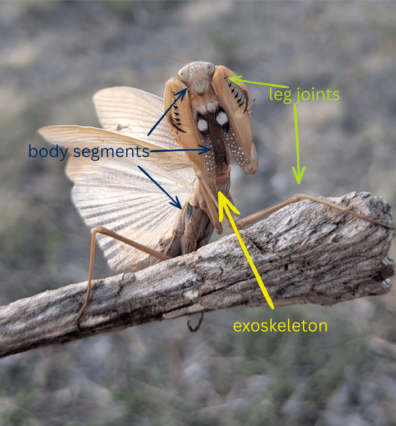
Here you can see the features that make an insect an arthropod. This praying mantis has an exoskeleton covering its body. It has legs with bendy joints. It has three body segments—head, thorax and abdomen. ©Larry Clark
An arthropod has a “skeleton” on the outside—an exoskeleton. That’s a hard outer shell that protects and supports its body. To grow, an arthropod secretes a new exoskeleton and sheds its old one. Arthropods also have jointed limbs and segmented bodies.
Tons of animals are arthropods. That includes all insects, arachnids (spiders, mites, ticks and scorpions), crustaceans (crabs, lobsters, shrimp and pill bugs) and myriapods (centipedes and millipedes).
Your heart is part of a closed circulatory system. Your blood travels inside blood vessels. Your heart pumps oxygen-rich blood all over your body.
An arthropod has an open circulatory system. Its “blood” is called hemolymph. It mostly flows freely inside the arthropod’s body.
Lavine told me that some insects ooze a little hemolymph when they’re threatened. That’s called reflex bleeding. That can be toxic or just send a message.
“It warns the attacker that they’re dangerous,” she said. “Then they escape.”
Unlike your blood, hemolymph doesn’t usually carry oxygen. Insects don’t even have lungs. They take in oxygen through a row of tiny openings on their sides called spiracles.
Then they pipe that oxygen directly to their cells through a system of tiny tubes called tracheae.
Insects have just one blood vessel. That’s sort of like a heart. It runs along the insect’s back. It pumps hemolymph from the insect’s rear end to its head.
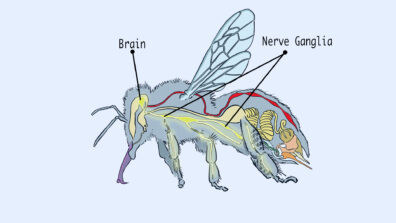
This diagram shows a bee’s internal organs. The brain and ganglia are neon green and labeled. The heart-like dorsal blood vessel is red. It pumps the blood forward to the brain. (Bee’s Internal Sensory Receptors, Nebraska Public Media, Used under PBS download and share license)
That bathes the brain in the insect’s head with nutrients and chemical messages. Then the hemolymph sloshes through the insect’s whole body.
But the insect brain isn’t as centralized as the mammal brain.
An insect’s brain connects to a long nerve cord that run along its belly. Along this cord are bundles of nerve cells called ganglia. They help control different body parts. The brain and ganglia work together to help an insect sense its surroundings and respond to them.
That takes less energy than powering one big brain. It also maximizes how fast an insect can act.
“If you had little brains everywhere else, you would also be much quicker,” Lavine said.
It’s not always easy to relate to animals that are so different from us. But that’s just how we each adapted to our environments. And those brains give some insects sophisticated abilities—like bees sniffing out bombs or diseases.
I guess you could say that’s just another way to bee an animal, surviving on planet Earth.
Sincerely,
Dr. Universe