Dear Bruce,
As a talking science cat, I’m a special case. Other cats meow, purr, chatter and chirp. But they don’t talk.
It turns out humans are the only animals with true language.
That’s what my friend Samantha Gizerian told me. She’s a neuroscientist at Washington State University.
She told me that talking works because of human anatomy and brain function.
The human mouth, throat and tongue are more flexible than those of other animals—even other apes.
The throat houses the voice box, or larynx. The vocal cords sit inside the voice box. They vibrate when air from the lungs blows past them. Then the throat, tongue and mouth shape the vibrations into sounds that make sense to humans.
“If you look at the throat structure in non-human apes, their larynx is higher,” Gizerian said. “And there’s a vocal membrane across the top. That actually prevents them from making the variety of sounds that we can make.”
Humans don’t have that vocal membrane—but some of their ancestors probably did. Over millions of years, the human voice box got simpler. The vocal membrane went away. That simplification made talking possible.
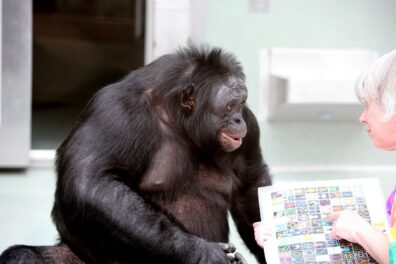
This is Kanzi, a Bonobo ape. He couldn’t talk, but he could understand human language—through sign language and lexigram symbols. Dr. Gizerian met Kanzi when she was a student. “He promptly took in a mouth full of water out of his pool and proceeded to give me an ape shower,” she said. William Calvin CC BY-SA 4.0

The human brain adapted for talking, too.
Your brain has a language network to help you understand what someone says and respond. That includes regions of the brain like Wernicke’s area, which helps you understand language, and Broca’s area, which helps you plan what to say back. The language network is connected by nerve pathways so the parts can work together.
Your brain also coordinates the movements that produce words, with help from the motor cortex. That’s the part of the brain that moves the muscles you can control—like the ones you use to talk. It’s how you move your lips and tongue and control your voice box.
Humans have gobs of brain cells and connections in the parts of the motor cortex that control the face, lips, tongue, mouth, throat and voice box. That gives you finer control over those muscles.
“Those two areas and the connections between them don’t exist in our animal friends in the same way they do in humans,” Gizerian said. “So, our brains have a unique ability to understand and then output language. They also have all of that specialized real estate for manipulating the parts of our body that do the talking.”
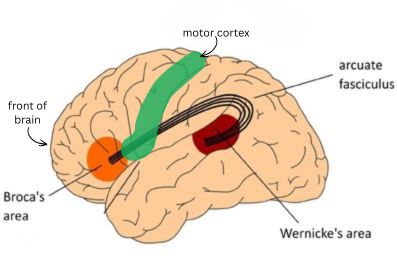
Here’s your brain with Broca’s area (orange), Wernicke’s area (red) and the motor cortex (green) highlighted. Broca’s area and Wernicke’s area connect via a bundle of nerves called the arcuate fasciculus. Peter Hagoort CC BY 3.0, green highlight and two labels added by Dr. Universe

Cats have a voice box with vocal cords like yours. Like you, they don’t have a vocal membrane.
But they still can’t talk. A cat’s mouth, throat and tongue aren’t flexible enough. They can’t move those muscles to form vowels and consonants. And they lack the brain connections and language network to learn and make complex language.
So, they express themselves in other ways.
Cats use body language to say how they feel—like tail movements, ear position and slow blinks. They’ve adapted to pick up chemical messages from each other using smells. They use some vocalizations, too—like yowls, hisses and meows. Cats even have extra pads on their vocal cords for purring.
So, even though your cat can’t talk to you, it can still communi-cat.
Sincerely,
Dr. Universe