Dear Bobo,
There’s nothing more magical than sparkly flakes gently falling on a fluffy blanket of snow. But it’s a temporary kind of magic. When it warms up, the snow disappears.
I asked my friend Jennifer Adam what’s going on. She’s a water scientist at Washington State University.
She told me snow is frozen water. When temperatures rise, it melts. The solid frozen water turns back into liquid water.
That melted-snow water works just like rain water. It soaks into the ground. It fills up the spaces between bits of underground soil and rock. That’s the water that plants slurp up with their roots.
“But the soil can only hold so much water,” Adam said. “If you think of a sponge under the faucet, it fills, fills, fills, fills. At some point, it’s going to overflow the top.”
Once the ground is full of water, any extra water just flows over the ground. Some of it drains into streams and rivers. Eventually, it makes its way to the ocean.
Some of the water evaporates. It changes from liquid into gas. That water vapor hangs out in the atmosphere. Someday it will return to the Earth as rain or snow.
Adam told me that snow and how it melts is super important in Washington state—especially the snow held high up in the mountains. It’s called snowpack.
All winter, that snowpack piles up. It’s like a frozen water storage system. As temperatures warm in the spring, the snowpack slowly melts. The water runs down. It fills the ground and flows into rivers and streams.
That’s important because Washington has a timing mismatch. We get most of our precipitation in winter. But we use most of our water in the summer.
A generous snowpack stores lots of water and then slowly releases it, so the ground and rivers fill up slowly. That’s the water farmers use to irrigate crops and grow food. It also turns turbines in dams on rivers to make our electricity.
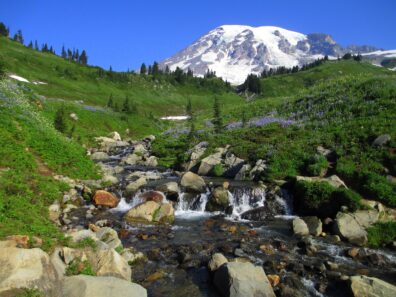
This is Mount Rainier in August. There’s still snowpack remaining—but lots of water has melted and filled up the ground and streams. Samuel Kerr CC BY-SA 3.0

Scientists aren’t sure what’s going to happen with our water supply in Washington as the planet warms. We might get more precipitation or less precipitation. But we do know that it’ll get warmer. That means our wet winters might bring more rain instead of snow.
Without a healthy snowpack, water might rush into our rivers in winter, when we don’t need it as much. It might be gone by summer, when we really do.
That’s why experts like Adam study the local water system closely. By carefully monitoring snowpack and changes in our environment, they can plan how to manage our water.
It’s all about tracking data to s-know how to adapt to a changing world.
Sincerely,
Dr. Universe