Dear Jerry,
Like most cats, I love watching robins. They hop across the grass then pause and tilt their heads to one side. Soon —jab!—they pull a wiggly worm from the soil.
I asked my friend Heather Watts what those robins are doing. She’s a bird scientist at Washington State University.
She told me that robins use two senses to find worms.
“The existing evidence is that they use both visual and sound cues to find worms,” Watts said. “Depending on the environment, they might use one more than the other.”
Sometimes robins see what they’re hunting. They may notice tiny movements in the soil. Or they might spot small holes in the ground—or even a bit of a worm poking out of a hole.
That’s probably why robins tilt their heads while hunting.
Unlike us, robins have side-facing eyes. That maximizes their field of vision so they can scan for predators—like curious cats taking a break from answering science questions.
The sharpest vision happens right at the center of a robin’s eye—called the fovea. So, when a hungry robin wants to grab a worm, it tilts its head. That lines up its sharpest focus directly over the patch of ground it’s inspecting.
That pose also frees the other eye to scan the sky for danger.

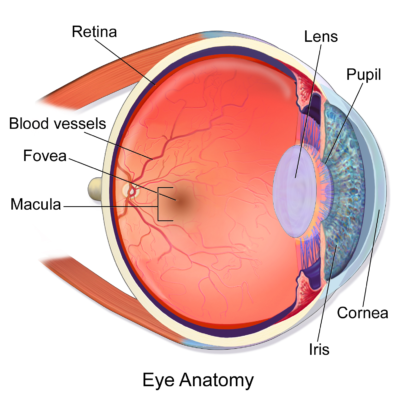
Robins are mostly prey animals. (Unless you ask a worm.) That’s why their eyes are on the sides of their faces. Predators usually have forward-facing eyes—like cats, humans and owls. You have a fovea—or spot with super sharp vision—in your eye, too. If you unbend a paperclip and look at the end of the wire, that’s about the size of your fovea. It’s the only part of your eye that can achieve perfect 20/20 vision. ©Jef-B CC BY-NC ©Blausen.com staff CC BY 3.0

Sometimes robins hear what they’re hunting. As worms move through soil, their skin rubs against grains of dirt. That makes rustling or crackling sounds. If a worm’s tunnel is wet, it might make gurgling noises. Those sounds are too quiet for humans to hear.
Scientists aren’t sure whether robins rely more on sight or sound. A robin probably uses its eyes in open areas with good visibility. Or when noise—like high winds or traffic—make it harder to hear. If the worms are hidden by grass or rocks, a robin may use its ears more.
Scientists don’t think robins use their other senses to hunt—like feeling vibrations in the soil or sniffing out worms.
This is what earthworms sound like in a microphone. Some scientists think robins can tell if soil is “noisy.” That kind of soil has the underground sounds of worms and insects—and the noises made by plants growing. ©USDA ARS
It turns out the robins I see outside may not be hunting worms at all. Worms are only about 20% of a robin’s diet. They mostly eat fruit and other tiny invertebrates like insects. But there are times when robins eat lots more worms.
“Worms are a particularly important part of the diet during the breeding season—so spring into summer,” Watts said.
That’s when adult robins are feeding hungry chicks. Worms are a nutritious snack for growing birds.
So, when a robin scans the ground, it might not even be looking for worms. It could be searching for beetles or other tasty finds.
I guess you could say there’s a lot of wiggle room in the process.
Sincerely,
Dr. Universe