Dear Edgar,
I like school so much that I live at a university. But I know that’s not true for everybody. School can feel great for some kids and really hard for others.
I asked my friends Brian French and Paul Strand about it. They’re psychologists and researchers at Washington State University. Their team developed WARNS. That’s a tool to help identify kids at risk of dropping out—so adults can help them.
They told me there are lots of reasons kids miss school or decide to drop out.
Some reasons have to do with the school or community. Sometimes students don’t feel welcome or safe. They may not see how what they’re learning connects to their real lives.
For some kids, just getting to school is tough. The walk might be long or unsafe. Buses might not come regularly.
Other reasons have to do with what’s going on in the student’s life. Some kids feel anxious about school or get overwhelmed. Others have big responsibilities—like working or taking care of siblings. If they know someone who dropped out, it might feel like it’s no big deal.
Money problems can make all this harder. About 35% of students are from low-income families. That means millions of kids may not have the things they need—like clothes that fit, hygiene supplies, or reliable electricity and water. If they miss the bus, they may not have a car or parent available to give them a ride. That can make life more stressful and school extra hard.
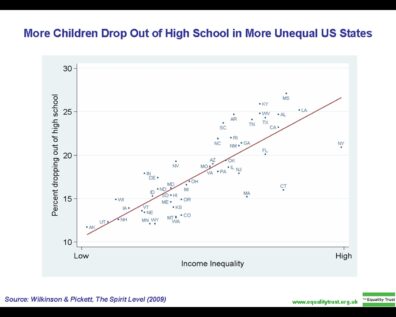
This kind of graph is called a scatter plot. It has a red regression line on it to show the overall trend—or big-picture pattern. This scatter plot shows that teenagers are more likely to drop out in states where some people have a lot of money and others have very little, even when they all work hard. ©The Spirit Level, Wilkinson & Pickett, Penguin 2009

Missing school a lot can add up.
“It’s a path that sneaks up on kids,” Strand said. “They drop out because a bunch of factors slowly worked against them.”
That’s a big deal because finishing school helps people. Graduates are more likely to be healthier, earn more money, and have more choices.
Schools want to help. Some offer free meals to all students, so no one feels singled out. Others provide clothes, supplies, or even a place to shower. Public support helps schools get those services to kids—so they can focus on learning.
The first step is knowing who needs help. That’s why French and Strand created their tool.
“What we’re trying to do with WARNS is focus on giving students and counselors or administrators information,” French said. “So, they can start a conversation with the student to figure out what’s going on—and help the student move forward.”
They’re even working on a version for elementary schools.
Because the sooner adults notice a problem, the easier it is to help kids get their paws on a life-changing education.
Sincerely,
Dr. Universe