Dear Skye,
Every weekend, I make pizza dough. I love watching the dough bubble and rise.
I asked my friend Mel Darbyshire why that happens. She’s head of baking at Washington State University’s Breadlab. There, scientists and bakers work together to develop grains that make super bread.
It turns out bread rises because it contains yeast.
Yeast is a microscopic, single-celled fungus. Like all living things, yeast needs energy to grow and reproduce. It gets that energy by eating sugar.
When I make pizza dough, I mix together warm water and sugar. Then I sprinkle a packet of yeast over the top and wait. Soon, the liquid gets frothy and bubbly. That’s called blooming.
It happens when the yeast chow down on the sugar in my mixture and burp out gases—carbon dioxide and ethanol. Those gassy burps make my mixture foamy.
Scientists call the process where yeast cells consume sugar and release gas fermentation.
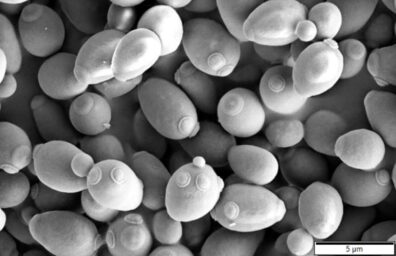
This is baker’s yeast, or Saccharomyces cerevisiae. If you peek inside a packet of yeast, you’ll see grains. Each grain contains billions of yeast cells clumped together. Those yeast cells are dormant. They’re dehydrated and inactive—but they’re still alive. They need warm water and sugar to fully wake up. Mogana Das Murtey and Patchamuthu Ramasamy CC BY 3.0

Next, I add flour to my mixture and knead it. Kneading stretches the proteins in the dough—called gluten. That makes the protein strands link up in an organized way. If you looked at my dough under a microscope, you’d see a network of proteins—like a strong web.
Sometimes dough needs to sit and rise. That’s called proofing. It gives the yeast time to eat more sugar and burp out more gas. If the gluten proteins are nice and strong, their web will trap the gas inside the dough. That makes it expand.
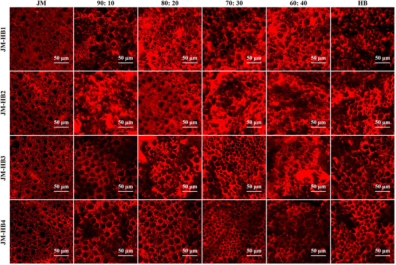
This is what a web of gluten protein looks like under a microscope. The web traps gas burped out by yeast. That gives bread its fluffy, airy structure. Yu et al. CC BY 4.0
When I pop my dough in the oven, it rises again.
“It’s like the yeast having their final shout,” Darbyshire said. “Because of the heat in the oven, there’s a rapid rise called oven spring.”
How much the dough rises in the oven depends on many things. It needs strong proteins to trap the gas. It needs just the right amount of heat. That heat changes some of the water in the dough into gas, too.
But dough can only rise so much. Eventually, it develops a crust. That’s too hard to stretch against. Plus, once the dough reaches about 120 degrees, the yeast cells die. It’s just too hot for them.
At that point, the rising is over—but the science isn’t. A chemical reaction makes the crust dark and toasty. Part of that comes from sugars the yeast left behind.
“The bake color comes from gelatinization of the starches,” Darbyshire said. “It’s called the Maillard reaction. The crust gets thicker and darker, depending on how many sugars there are and how they gel.”
So, yeast is why bread—and my pizza dough—rises. It’s why it’s fluffy and full of spongy holes. It also helps the crust get dark and toasty.
All because of a tiny single-celled fungus. I guess the y-east you could say about those guys is that they really rise to the occasion.
Sincerely,
Dr. Universe