Dear Brianna,
I once took an anthropology class to learn about humans. We went to the zoo to observe primate behavior.
I asked my friend Nanda Grow about the behavior you describe—throwing poop. She’s a biological anthropologist at Washington State University. She studies primates like tarsiers.
She told me there are lots of reasons a captive gorilla might throw poop. It may feel threatened or overstimulated. Or it could be reacting to its environment in a playful way.
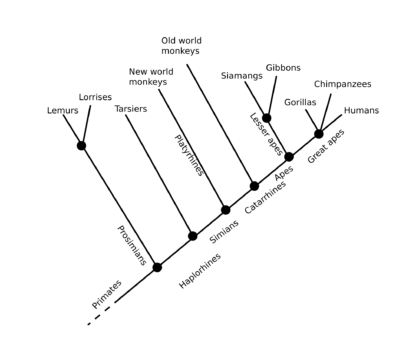
This is a cladogram. You can see dots like nodes where a line splits off the main line. That shows when each kind of primate split off into its own group, relative to other primates. You can see that tarsiers split off earlier than gorillas. The dot is the common ancestor tarsiers share with other primates. On the right, you can see humans share a common ancestor with chimpanzees. All primates have strong cognitive abilities, eyes that face forward and grasping hands.
Gorillas in the wild never throw poop. They never throw any objects. They live in small family groups. They spend their time quietly eating leaves and resting.
The leader of a gorilla family—called a silverback—might fight to protect its family. But that doesn’t happen often. And the other gorillas don’t fight at all.
That’s very different from chimpanzees. Those primates live in big groups. They fight a lot. They throw objects at each other all the time.
Grow said that normal primate behaviors can help us understand unusual behaviors in captive gorillas—like throwing poop.
“We can’t get inside the gorilla’s brain to understand its internal motivation,” Grow said. “We need to look for context clues. Do we see similar signs of aggression like we might see in wild chimpanzees? How was the gorilla acting before and after the throwing behavior?”
It’s possible the captive gorilla feels threatened.
When great apes sense a threat, they get tense and upright. They direct their gaze at the target. They might show their big, sharp canine teeth. Sometimes they do fake-out lunges, slap the ground or beat their chests.
Those are all ways to communicate that the ape wants the target to back off.
If a captive gorilla acts like this—and throws poop at a specific person—it probably feels threatened.
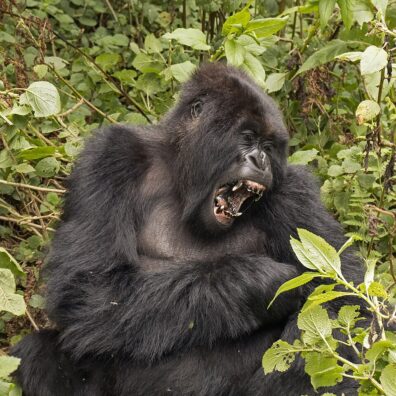
You can see this mountain gorilla’s huge chompers. But she’s not upset at all. She’s yawning. It can be tricky to understand the behaviors of other animals. Charles J. Sharp CC 4.0
_yawn.jpg)
It could be that the captive gorilla feels overstimulated.
A busy zoo is very different from the quiet habitat gorillas adapted to live in. It might be overwhelming or confusing.
An overstimulated gorilla may act restless. It may pace or rock. It might do the same behaviors over and over.
An overwhelmed gorilla may throw poop. It probably doesn’t have a specific target.
It’s also possible for a captive gorilla to throw poop for fun. When humans see flying feces, they freak out. A curious gorilla might think it’s interesting to watch the humans react. It’s a social exchange.
After all, the gorilla exhibit is two kinds of primates—gorillas and humans—observing each other.

These wild mountain gorillas are babies. They’re playing like kids do—while a grownup dozes behind them. In the wild, their play would never include throwing objects. Charles J. Sharp CC 4.0
_three_2-year-olds.jpg)
Grow told me that zoos do important work to help animals like gorillas.
“I’m very pro-zoo, especially AZA-accredited zoos,” she said. “Zoos do fabulous things to conserve wild primates and educate people.” AZA is the Association of Zoos and Aquariums.
That’s why zookeepers pay attention to primate behavior. If an animal seems to feel threatened or overstimulated, they adjust its environment. Plus, there’s usually a quiet part of the enclosure that’s away from the public. So, a gorilla interacting with human visitors is mostly there by choice.
And how it behaves is ape-solutely dependent on context.
Sincerely,
Dr. Universe