Dear Jake,
Right now, Washington state uses water through dams to make most of our electricity. But we’re also working hard on another kind of renewable energy: solar.
I asked my friend Allie Higginbotham about solar panels. She’s a scientist who works with the Energy Program at Washington State University.
She told me that a solar panel is a device that uses the sun to make electricity.
“A solar panel is made of smaller units called photovoltaic cells, or solar cells,” Higginbotham said. “They’re arranged in a grid on a solar panel—like you see on rooftops. A bunch of panels strung together is a photovoltaic array. Its job is to convert light into electricity.”
Each solar cell is about the size of a cell phone. But it’s super thin—like two sheets of paper stacked together. A solar panel contains many solar cells.
If you could zoom in on a solar cell, you’d see gobs of teeny, tiny silicon atoms—many septillions of them.
Those silicon atoms sandwich together in two layers in a solar cell. Each layer has little bits of other elements added to it. That helps create an electric field that pushes electrons in one direction.
If you look up silicon on a periodic table, you’ll see its atomic number is 14. That means a silicon atom has 14 protons. It usually has 14 electrons, too. They whizz around it like a cloud.
When the sun’s light hits a solar panel, the bits of light—called photons—bang into the silicon atoms. They knock some electrons loose. That leaves empty spots where the electrons used to be.
The solar cell’s electric field pushes the loose electrons up to the top. Then metal parts on the solar cell collect the electrons.
When electrons flow together in one direction, that’s an electric current.
The electric current moves out of the solar panel. It flows into copper wire. Then it travels off the roof and into a machine that changes the type of current from DC to AC. That makes it usable by the outlets in your home.
The electrical current travels through more wire into your breaker box. Then, it’s sent out to your electrical outlets. You use that electricity to power your lights and devices.
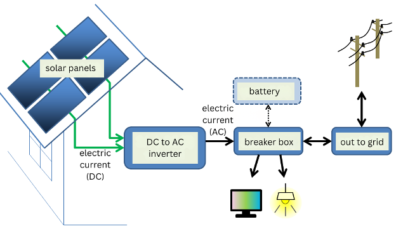
Electric current moves from the solar panel to the outlets in your home. The current starts as DC, where electrons mostly go in one direction through the wire. Then it’s converted into AC, where the electrons move back and forth very quickly.
Electricity always needs a complete path to flow. That complete path is called a circuit—because the electric current moves through a whole loop.
If it’s super sunny, your solar panel might make more electricity than you can use. Your system might save some in a big battery. It might push some into the shared electrical grid. Your neighbors can use it. The power company tracks how much electricity you shared. Then you can use electricity from the shared grid when you need it—like if it’s a very cloudy day.
When it comes to making electricity, solar panels really shine.
Sincerely,
Dr. Universe