Dear Kovas,
When I work honey bee hives, I always wear a beekeeping veil. It protects my head and face from bee stings.
That’s important because a honey bee colony is a superorganism. It’s made of thousands of individuals. They work together like one living thing.
If that superorganism feels threatened, I might get stung—a lot.
I talked about it with my friend Brandon Hopkins. He’s a honey bee scientist at Washington State University.
He told me that smoke interferes with the way honey bees communicate with each other.
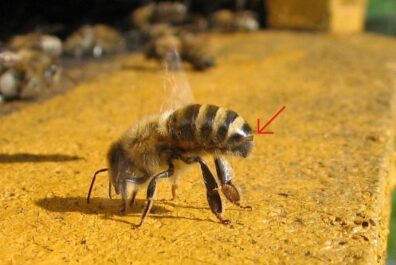
This bee is sending out a pheromone from cells near its stinger. That spot is the Nasonov gland. It produces homing pheromone, which helps bees find their hive and each other. The Koschevnikov gland produces alarm pheromone. It’s a little further down on the belly side of the bee’s abdomen. © Björn Appel CC BY-SA 3.0

Nearly every biological process in your body is managed by hormones. They’re chemical messages that travel in your blood. That’s how your body sleeps, eats and uses energy, reproduces, responds to stress and handles stuff like your body temperature.
Honey bees work together using pheromones. Those are ecto-hormones. They’re chemical messages that travel through the air between individual bees.
That’s how a honey bee colony works and sleeps, finds food and feeds each other, reproduces, responds to stress and handles the temp inside the hive.
One of these chemical messages is called alarm pheromone.
“When someone comes along and tries to get into the hive, honey bees release alarm pheromone,” Hopkins said. “Then they work together to protect the developing brood and food resources.”
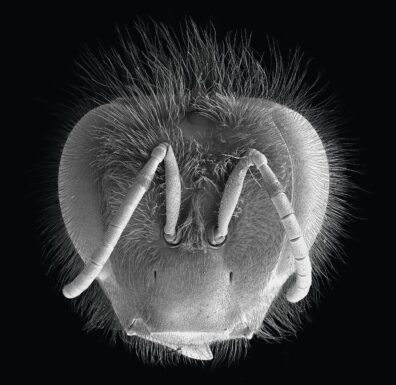
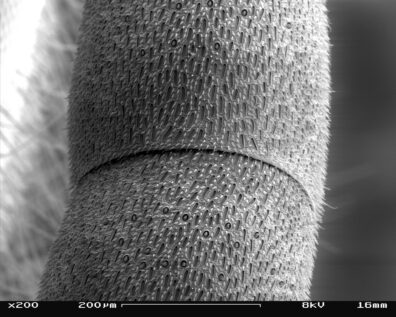
These are microscope images of a honey bee’s head (left) and a wasp’s antenna. (Bees and wasps are cousins. They share an ancient wasp ancestor.) You can see the teeny tiny sensors that pick up chemical messages. ©Lukas Herold CC 4.0, secretdisc CC 3.0


When I open a hive, that’s scary for bees. Everything important to them is in there—their relatives, their babies, all the food they’ve gathered and stored.
So, the bees tell each other about the threat. They start pumping out alarm pheromone. It’s made of more than 40 chemicals. One smells like artificial banana candy—and people can smell it.
Alarm pheromone is made and secreted by a gland near the bee’s stinger. It travels through the air. Receptors on the antennas of other bees pick up the chemical message.
Now all those bees know I’m breaking into their hive. They can work together to defend their colony.
That’s bad for me because bee stings hurt—and can be deadly for people who are allergic. It’s also bad for the bees. Honey bees have barbed stingers. The sharp barbs get stuck in elastic skin like ours. So, a honey bee can only sting us one time, and then it dies.
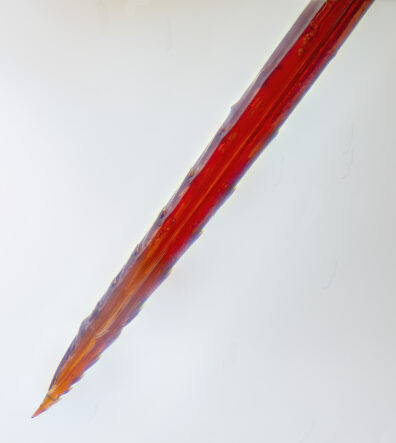
You can see lots of poke-y barbs in this honey bee stinger. The stinger gets stuck in our skin, and the bee doesn’t survive. That’s sad for the individual bee, but it helps the superorganism colony survive. Honey bees can safely sting animals without skin—like other insects or spiders. And other kinds of bees and wasps have smooth stingers, so they can safely sting anybody. ©Fedaro CC 4.0, arrows by Dr. Universe

That’s why I use a bee smoker before I open a hive.
The smoke makes it hard for alarm pheromone to travel in the air. It interferes with how the bees pick up the chemical message. Plus, smoke seems to reduce how much alarm pheromone each bee pumps out.
If the bees don’t pick up the alarm message, they won’t respond like I’m a threat. I can work the hive without scaring them.
Some bees change their behavior after smoking.
“When you smoke the bees, you’ll see some of them with their heads stuck in the honey and nectar cells in the comb,” Hopkins said. “They’re gorging themselves on honey.”
Nobody is sure why bees do that. But even if some bees pick up the alarm message, the bees snarfing up honey will be too busy to attack me. Then I can get away and try again when the bees are calm.
Smoke is just a tool that helps us bee respectful caretakers of these important animals.
Sincerely,
Dr. Universe