Dear Ruby,
As a kitten, I needed my mom for a long time. She fed me and kept me safe—for 12 whole weeks.
That’s nothing compared to my human friends. Where I live, human parents provide for their kids into their 20s.
I asked my friend Courtney Meehan why humans grow up so slowly. She’s an anthropologist at Washington State University. She studies child development and parenting all over the world.
It turns out human babies are born helpless because of how human bodies and societies evolved.
It started with two adaptations: walking upright and big brains.
Human ancestors climbed lots of trees. They walked on all fours. Then some of them began walking upright. That helped humans reach food and carry it. It made it easier to scan for predators. It saved energy and kept them cooler.
Eventually, early humans became the walking, tool-using people you probably imagine. They tried new foods and started cooking over a fire. That made food easier to chew and digest. So, the human jaw and digestive system adjusted. Changes to our diet help support our bigger brains. But walking upright reshaped the pelvis. That made it super hard to birth big-headed babies.
Humans adapted by giving birth earlier, when the baby’s head is smaller. That means newborn babies are smaller and extra helpless. They’ll grow a lot as babies. By the first birthday, a baby’s brain doubles in size—and the head grows about 5 inches.
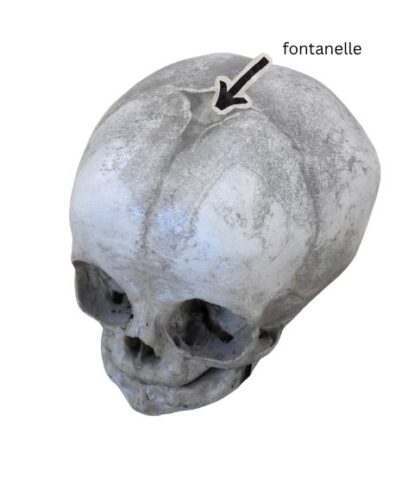
This is a model of a newborn baby’s skull. It’s made of 7 bone pieces connected by joints called sutures. That allows the skull to flex a little bit during birth. The open spaces between bones are fontanelles, or soft spots. They’re protected by tough tissue—but babies need extra gentle care while they’re open. The fontanelles usually close by the baby’s second birthday.
Big brains help humans live in super complicated groups.
“This trade-off happens,” Meehan said. “We give birth to more highly dependent offspring, and it takes us a long time to rear them to independence. But the benefit of that is our large, complex brains are really attuned to social interactions and language.”
Many animals rely on the instincts they’re born with. Baby spiders just know how to spin a web. Kittens and cougar cubs automatically climb up to avoid danger.
But little humans need to learn most things. They learn to talk. They figure out how to tell who’s in their group. They learn how to behave around other people.
That’s important because humans live in fission-fusion societies. Their groups change a lot. Some early humans went off to hunt or forage. Then they came back together again. Today, many families go to school or work. Then they come back together. Sometimes human groups stay apart for a long time—like over the summer or even for years. Human brains keep track of who’s important and how to interact with them—even if it’s been a while.
Meehan told me that there’s one strategy humans use that other great apes don’t. They sometimes have children with small age gaps—so they still require a lot of care. Other great ape juveniles are more independent before their mother has another baby.
“To support that, we help each other with child-rearing,” Meehan said. “Among other primates like chimpanzees, you don’t often see moms sharing their infants very widely.”
That task sharing is called alloparenting. Alloparents can be family members, friends or teachers. They all work together to raise the kids.
How much that happens varies a lot. Parenting looks different for different humans adapting to where they live—and helping their young succeed.
That kind of variability makes humans stronger. For nature, it’s a big-brainer.
Sincerely,
Dr. Universe