Dear Neve,
When I sit around a campfire with my human friends, we’re all swatting mosquitoes.
I asked my friend Jeb Owen about that. He’s an insect scientist at Washington State University.
He told me that most mosquitoes bite non-human animals.
“A very small number of species bite people,” Owen said. “Most mosquitoes are relatively specific. They bite a narrow range of animal types.”
There are nearly 4,000 species of mosquitoes in the world. Usually, they sip nectar from flowers. But sometimes female mosquitoes crave something special: a blood meal. They need the proteins, fats and iron in blood to make eggs.
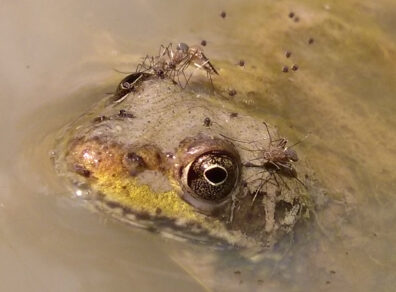
These female mosquitoes adapted to feed on frog blood. Like chicken eggs, mosquito eggs contain a yolk to nourish the baby mosquitoes. That yolk is possible because the mosquitoes slurped up the right kind of blood.
Animal blood isn’t all the same. It has different amounts of water, fats and cells. It always has proteins made of amino acids. But the mix of amino acids is different in different animals.
A mosquito that normally feeds on bird blood might not get the right amino acids from drinking human blood. That might make it hard or impossible to make eggs.
So, mosquitoes have adapted to feed on specific animals.

This is what a female mosquito’s mouth parts look like up close. She has two antennas and two maxillary palps (one is hidden under the proboscis here). Those parts detect carbon dioxide and other scents. Her labellum has even more sensors and guides the bite. Her proboscis is made of six needles. Two have saw-like teeth to make the bite. Two hold the bite open. Another drips mosquito saliva inside. The last needle slips into a blood vessel and slurps up blood. Pitts & Zwiebel CC 2.0
First, mosquitoes need to find the right animal. They sniff out the carbon dioxide that animals exhale.
“They fly upwind through that cloud of CO2, kind of like a hound dog tracking the scent of an animal on the ground,” Owen said. “They’re tracking our scent through the air until they get close enough to smell other smells that we have.”
Those smells are volatile chemicals. Your mix of volatile chemicals comes from what you eat and what microbes live on your skin.
Mammals like us smell different from birds. Birds smell different from reptiles or amphibians. Even different species in the same group emit different scents.
A mosquito knows the correct smell for its host animal. So, when the receptors on its antennas and mouthparts pick up the right combo of smells, it locks in on the target.
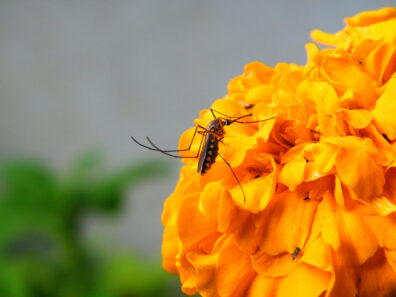
Most of the time, female mosquitoes drink flower nectar. That’s all male mosquitoes ever eat. Nobody knows exactly how mosquitoes adapted to sometimes feed on blood. But it must be a good strategy because more than 30,000 species of animals drink blood. When different kinds of animals adapt at different times to do similar things, that’s convergent evolution. Abhishek Mishra CC 3.0

Now it’s time for the mosquito to get to work.
“When mosquitoes arrive, they use these long cutting mouthparts to cut a hole into the skin and the blood vessels to extract blood,” Owen said. “When that happens, there are essentially alarm signals that go off in the body at the cellular level. Those particular responses are unique among different animals.”
The alarms send messages in the animal’s body. They tell it to clot the blood. They urge the immune system to crank out fighter cells. That’s important because some mosquitoes carry pathogens that can make you sick.
When the body responds to those alarms, the bite gets red and itchy. That might make the animal swat the mosquito.
That’s not great for the mosquito.
So, mosquitoes adapted their saliva. It contains chemicals that stop clotting and slow down the immune response. It also blocks the pain of the bite.
“Mosquitoes have evolved a salivary pharmacy to block or suppress all of your defenses,” Owen said. “Each animal species has a unique tweak on its defenses. If a mosquito wants to use blood from that animal, it has to evolve salivary chemistry to deal with that animal’s defenses. That means her salivary chemistry only works for that animal.”
Nobody loves getting bit by a mosquito. But they’re important members of our ecosystem. They pollinate and keep some animal populations in check. They make a great dinner for birds, fish and other animals. And the baby mosquitoes that hatch from those blood-fed eggs will cycle nutrients in our water.
They’re complicated animals. And they really leave me itching to know more about them.
Sincerely,
Dr. Universe