Dear Kalani,
As a cat, I don’t have many sweat glands. That can be a bummer. Especially when I’m chasing butterflies with my human friends. Sometimes butterflies land on my less-furry pals. They’re tasting the salt on their sweaty skin—with their teeny butterfly feet.

Sometimes butterflies puddle in mud. They’re tasting salt and nutrients in the mud. That’s what these Eastern tiger swallowtail butterflies are doing. Some butterflies puddle on specialized things—like mammal sweat and tears or even carrion. ©Grayson Smith/USFWS
I asked my friend Rich Zack about that. He’s an insect scientist at Washington State University.
He told me that butterflies use their feet to sample what they land on.
“If they’re walking across a leaf, that leaf is giving off all kinds of signals,” Zack said. “So, instead of having to feed on that leaf to evaluate it, the structures on their feet allow them to walk over the leaf and do preliminary tasting. That’s a first evaluation.”
Tastes are chemical signals. They’re picked up by gustatory (taste) receptors in some of the butterfly’s cells.
Let’s say a butterfly is looking for a sweet meal. As it walks around, it taps the plant with its feet. If the plant contains the right sugar, its taste receptors will grab little bits. When the sugar binds the receptor, the receptor changes shape. That opens a channel in the receptor.
Ions—positive and negative particles like sodium—flow through the open channel. That flow makes an electrical signal. It zooms down the butterfly’s nerves with a clear message: “Yummy. Eat this.”
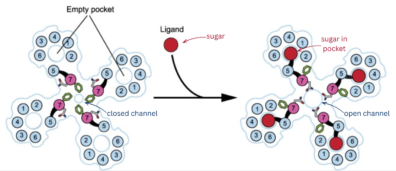
This is what a gustatory (taste) receptor looks like. The receptor on the left has empty pockets. Its center channel is closed. The receptor on the right has bits of sugar in its pockets. That changed the receptor (see the change at the pink 7 circle). It opened the channel. An open channel sends an electrical signal to the insect’s nerves. ©João Victor Gomes et al. CC BY-NC 4.0, red and blue labels by Dr. Universe
Some taste receptors are universal. All insects have them. They could be on an insect’s mouthparts, antennas, wings, egg-laying organs or feet. Other taste receptors are unique to different species. They can bind salty or sweet things. They can bind bitter stuff—like toxins in a poisonous plant.
Male butterflies use their feet to find tasty meals and nutrients for themselves. But female butterflies need to find the right plants for their babies, too. Most caterpillars are specialists. They only eat specific host plants.
That’s why a female butterfly has way more taste receptors on its feet. It drums on different plants, tasting for the perfect place to lay eggs.

These are the feet of male (left) and female (right) postman butterflies. You can see the female butterfly has extra taste sensors (arrow) and spikes. When male and female individuals have a big physical difference like this, it’s called sexual dimorphism. ©Adriana Briscoe et al. CC BY 4.0, image cropped by Dr. Universe
“If you think about the purpose of the different receptors, it makes sense that the female has a lot more receptors bringing in information for the survivability of her offspring,” Zack said. “She has to find the right food. She has to find the right habitat. That’s all up to her.”
It’s a big responsibility. But thanks to all those taste receptors, butterfly moms don’t have to wing it.
Sincerely,
Dr. Universe