Dear Florian,
Humans have lived in partnership with cats like me for a long time. The earliest evidence for our friendship is 9,500 years old. Archaeologists found cat and human remains buried together.
But that’s nothing compared to how long humans and dogs have hung out. They might’ve been a duo for 30,000 years.
I asked my friend Sean Farley if that could have happened with bears instead. He’s a wildlife biologist in Alaska. He studied at the Washington State University Bear Center.
He told me that wolf biology made them good candidates to live with humans. That includes their social structure and physical needs. Bears…not so much.
Dogs share a common ancestor with gray wolves.
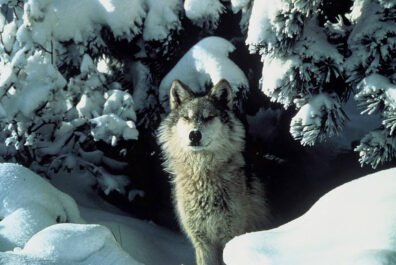
The scientific name for the gray wolf is Canis lupus. The scientific name for the dog is Canis lupus familiaris. So, technically dogs are a subspecies of wolves. But some experts disagree about this and use Canis familiaris for dogs. Taxonomy—the science of grouping and naming things—is complex. ©Tracy Brooks/USFWS
Sometime between 11,000 years ago and 32,000 years ago, dogs split from wolves on the family tree.
Scientists think those dog-wolves probably domesticated themselves.
Back then, humans were hunter-gatherers. Over time, some wolves became less fearful of humans. They became friendlier and more dog-like. They would have been great partners for hunters.
That probably wouldn’t have worked with bears. Bears don’t live and work together as a pack.
“Bears recognize a hierarchy, but it’s based more on size and dominance and fear—not a hierarchy of working together,” Farley said. “Even black bears can take down prey much larger than themselves by themselves. But for wolves to take down a moose, it really takes the pack effort to do it.”
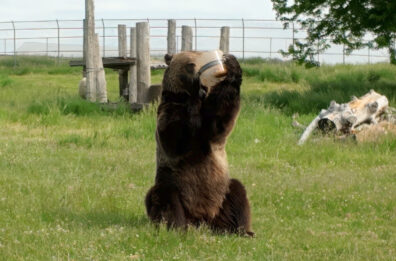
Bears are great problem solvers. But they don’t work together to do it. The WSU bears use their problem-solving skills to help humans. This canister is full of tasty stuff. The bear tries to break in to get the yummy snack—and people use that information to design bear-proof gear for campers. ©WSU College of Agricultural, Human, and Natural Resource Sciences
Plus, bears are massive—and ancient bears were even bigger. Think about the prehistoric cave bear. It definitely lived around humans. That ginormous bear weighed as much as 2,000 pounds. It would take tons of food to maintain their size.
As they sat by the fire, humans probably tossed bones and bits of meat to friendly wolves. That would have been a steady food source for them. But scraps wouldn’t be enough to feed a bear.
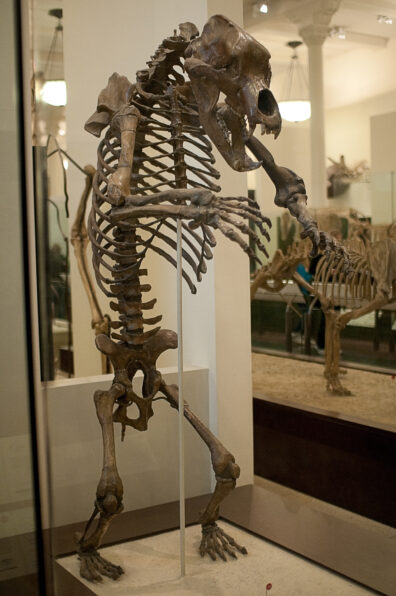
You can see this fossil skeleton of a cave bear at the American Museum of Natural History. We know humans lived at the same time as cave bears. They even drew pictures of cave bears on cave walls. People probably hunted cave bears. Scientists think that interactions with humans—plus the stress of the Ice Age—explain why this giant bear went extinct. ©Jan Dembrowski CC BY 2.0

Baby bears would be kind of a problem, too.
Wolf pups stay inside a den with their mother for a few weeks. Then they’re big enough to run and play with the pack.
Bear cubs are born while their mother hibernates. And they’re altricial—or super helpless. They won’t come out of the den for months.
“They don’t look anything like the bear cubs that you see running around in the springtime,” Farley said. “They can’t do anything except scream and nurse. And they’re like that for several months.”
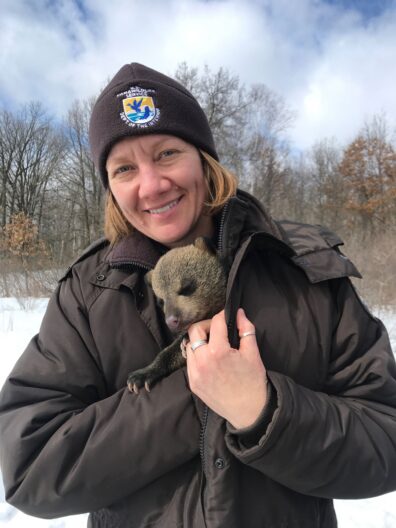
This biologist’s job is to keep a baby black bear warm while its hibernating mom gets a medical exam. Bears give birth while hibernating then snooze and feed their babies. Bears with cubs usually hibernate for four to six months. ©Shauna Marquardt/USFWS
That long hibernation and those needy babies wouldn’t have worked with the early human lifestyle. Hunter-gatherers moved around a lot. They traveled to find food and shelter from the weather. They met up with other groups of people. Humans would have had to change their whole lives to try to domesticate a bear.
I guess humans couldn’t bear the huge cost of trying to befriend those furry guys.
Sincerely,
Dr. Universe