Dear Adelynn,
My favorite planet is Earth. I can’t help it. It’s my cozy home.
It’s also a brilliant blue with bits of brown and swirly white. I like that I can look at a photo of Earth and see familiar things—like water and land.

This photo of Earth was taken by an astronaut on the recent Artemis II mission. ©NASA
To learn more about it, I asked my friend Michael Allen. He’s an astronomer at Washington State University.
He told me a planet’s color tells us a lot about the planet itself.
“What gives the planets their color? It’s twofold,” Allen said. “One is composition, and two is state. And they’re actually related to each other.”
State means whether a planet is solid, liquid or gas.
Earth is solid. It has some liquid water on the surface—that beautiful blue. But it’s mostly a rocky solid beneath our feet.
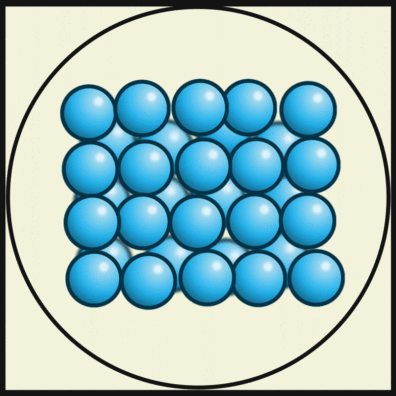
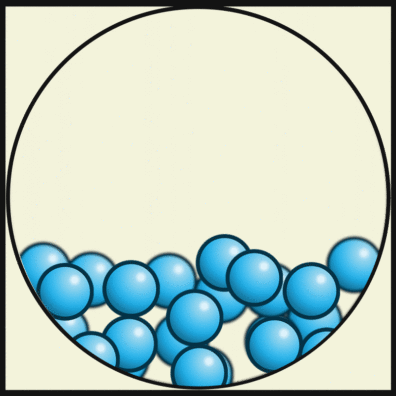
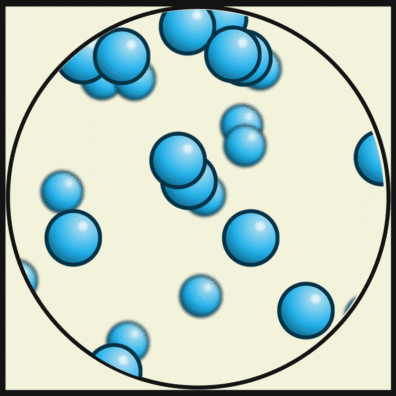
A state tells us how something’s atoms move. Solids (left) are tightly compacted. Liquids (middle) flow to fill a container. Gases (right) move the most. ©Julio Miguel A Enriquez and Monica Munoz CC BY-SA 4.0

Composition is what makes up a planet. Scientists who study how the planets formed group the materials in the early solar system into two categories: refractories and volatiles.
The difference between them is the temperature at which they become solid. In astronomy, “condensing” is when a gas changes to a solid. But sometimes we just say “freezing” when a liquid or gas changes to a solid—to keep things simple.
A refractory freezes at high temperatures. It changes from a liquid or a gas into a solid even where it’s super-hot—like next to the sun.
Refractories can be metal or non-metal. Iron is a metal refractory. Silicon-based things like glass are non-metal refractories.
A volatile only freezes when it’s super cold. It’s things like carbon dioxide—one of the gases we breathe out.
We see a planet’s color because of the way our eyes and brains process the sun’s light as it reflects off that planet.
That explains planet Earth’s color, state and composition.
The parts that look brown are rock and soil. They’re solid refractories. They’re full of metal and non-metal bits. The brown mostly comes from iron.
The parts that look blue are water. They’re liquid volatiles.
The parts that look like white, wispy clouds are tiny bits of ice and water in the atmosphere. They’re solid and liquid volatiles.
The colors of the planets tell us what they’re like and what they’re made of. But it helps us understand our solar system, too.
“There’s a change in color as you go from Mercury all the way to Neptune. That means there must be a change in temperature and composition,” Allen said. “The fundamental understanding of the solar system is that single observation—that composition is related to temperature, which is related to the distance from the sun.”
The inner planets are rocky. That’s Mercury, Venus, Earth and Mars. They’re made of solid refractories. Mercury contains lots of metal. Mars has much less. There’s a composition gradient as you move from Mercury to Mars.
The outer planets aren’t rocky. Their visible surfaces are mostly gases and ices. That’s Jupiter, Saturn, Uranus and Neptune. They’re made of volatiles.
Mercury is mostly metal. Metal bits froze together in that spot. By the time the cloud got to where Mars (middle) is, the metals were mostly gone. Bits of rock froze together there. Right before Jupiter, the temperature changes enough that the volatiles in the cloud could freeze. That boundary is called the ice line. The stripes we see on Jupiter happen because it rotates quickly. That makes the gases stream around the planet. The eye-shaped area is a whirlpool in the gases. ©NASA/Johns Hopkins University Applied Physics Laboratory/Carnegie Institution of Washington (Mercury), USGS Astrogeology Science Center (Venus, Mars), NASA’s Goddard Space Flight Center/Space Telescope Science Institute (Jupiter), NASA/JPL/Space Science Institute (Saturn) and NASA’s Goddard Space Flight Center (Earth, Jupiter, Uranus)
Back when the solar system formed, everything was a dust cloud. It was so heavy it collapsed in the middle. That made the sun.
The parts of the cloud near the sun were very, very hot. The cloud was full of refractories like rock and metal. It was full of volatiles like carbon dioxide.
The sun’s light and solar wind helped push the cloud away. The farther the cloud traveled from the sun, the colder it was. At different distances from the sun, different materials froze and clumped together to form planets.
You couldn’t come up with a more logical system if you plan-it.
Sincerely,
Dr. Universe