Dear Aditya,
When I was a kitten, car rides scared me. It took a while to trust my human pals’ driving.
I asked my friend Wei Peng if that’s how humans feel about self-driving cars. He’s a researcher at Washington State University. He studies public opinion on driverless vehicles.
He told me that self-driving technology is getting better.
“The safety performance of self-driving cars is improving,” Peng said. “It has even been deployed on public roads. In San Francisco, people can use a driverless car much like a regular taxi. And according to some studies, certain driverless cars have fewer crashes than cars driven by people in similar places.”
Human drivers scan the road with their eyes. They make decisions based on what they see and what they predict will happen.
But humans get distracted. They adjust the radio. They pay attention to other people in the car. Some people even text while driving. That’s super dangerous.
Self-driving cars don’t get distracted like that. But they can still miss things or make mistakes.
Instead of eyes, self-driving cars rely on sensors. Cameras read signs, spot traffic lights and watch lane markings. Radars send out radio waves to track the locations and speeds of moving objects—like other cars. LiDAR sensors emit lasers to measure precise distances between objects and fill in fine details. All that information makes a 360-degree map. The map changes as the car drives.
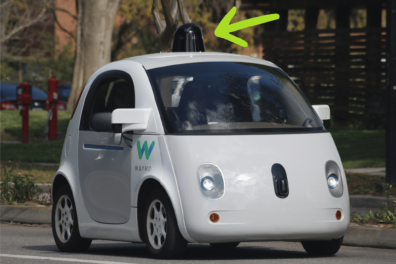
This is a prototype self-driving car. It cruised around Mountain View, California in 2017. The black, gumdrop-shaped device on top contains some of the car’s sensors. There are sensors all over the car, too. Grendelkhan CC BY-SA 4.0, arrow by Dr. Universe

Self-driving cars use a built-in computer with AI to process the mapped data. That’s how the car plans a route. It’s how it makes predictions and driving decisions. It sends out electrical signals to control the steering wheel, pedals and other car parts.
Driving decisions are high stakes. People put their kids and cats in cars. They want them to be safe. The driver—human or automated—must make careful predictions using context clues. For a human, context comes from interacting with the world their whole life. An AI system must be trained to understand all that context without the life experience.
Like, if an AI system spots a van on the side of the road, it needs to piece together what’s happening. Is it a delivery driver unloading a package? Or is it a mom unbuckling a toddler who might run into the road? The system needs to notice possible danger and prepare for what could happen next.
But that’s not the only big hurdle self-driving cars face.
Peng told me that the tech will need to overcome how humans feel about riding in a car that drives itself. It’s scary to see a steering wheel move on its own. It’s hard to relax when your taxi approaches a busy intersection—with nobody in the driver’s seat.
“It’s human nature to want to control the stuff we use,” Peng said. “This is particularly true when our safety is at stake.”

This pie chart shows how people felt about self-driving cars in a 2021 survey. The biggest segment—44% of surveyed people—thought self-driving cars were a bad idea. Only 26% of people thought it was a good idea. Another 29% weren’t sure. The researchers will probably do another survey to see if those opinions change over time. ©Pew Research Center
Getting comfy with self-driving cars might just take some time.
Some subway systems have been automated for a long time—starting in the 1960s. At first, people were scared. They worried about safety. They feared that human drivers would lose their jobs. That’s why some early automated trains kept human workers onboard for a while. Now, some subways are fully automated—and have been since the 1980s.
I guess trust is what drives the whole thing.
Sincerely,
Dr. Universe