Dear Angel,
My mom warned me about sitting too close to the TV. Many kittens (and kids) hear that.
I asked my friend Dr. Jenna DeWald if it’s dangerous. She’s an eye doctor. She went to college at Washington State University.
She told me watching TV up close won’t hurt our eyes. But there’s a historical reason people think it might.
“There’s no direct harm from a TV itself,” DeWald said. “It doesn’t emit anything harmful. But some TVs back in the day—like in the 60s—did emit some higher radiation. It was a manufacturing defect.”
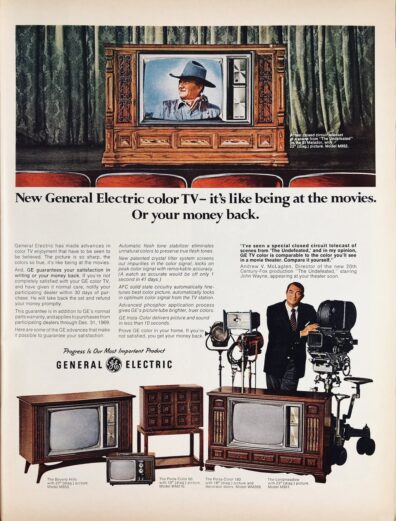
This is a 1960s ad for TVs. Back then, TVs were big and boxy—and sometimes looked like a wood-paneled piece of furniture.
Those old school TVs leaked X-rays. That’s the same stuff doctors use to take pictures of your bones or teeth. In small, controlled doses, X-rays are no big deal. But it’s unhealthy to absorb too many.
Your body is made of atoms. Each atom has a nucleus made of protons and neutrons. That’s surrounded by a cloud of electrons.
A rogue X-ray can zoom through your body and bang into atoms. It can knock some electrons out of the cloud. They fly off into nearby tissues. The remaining atoms are unstable.
That can harm your cells and DNA.
Fortunately, your body can fix that damage—or trash the cells or bits of DNA that are too broken to repair. But there’s a risk that some damage can stick around and cause problems.
So, people take X-rays seriously. That’s why healthcare providers are careful when taking pictures of your bones or teeth.
When people discovered those leaky TVs, they said not to sit too close. Then they repaired the TVs to block the leaks.
Today’s TVs don’t use X-rays at all. But those old leaky TVs were scary—and people don’t really remember why they weren’t supposed to sit close. So, the warnings have stuck around.
It turns out kids often sit closer to the TV because young eyes work better.
“Kids can focus very well with their eyes,” DeWald said. “If you give a kid a tablet or a phone or a book, they’ll hold it pretty close. That looks abnormal to adults—but a kid’s eyes can easily handle it.”
That up-close focus comes from the eyeball’s lens. The lens sits just behind the cornea (the part you can touch) and the colored iris. The lens is shaped like an M&M and made of clear proteins. It’s super flexible. Nearby muscles squeeze and relax to adjust the lens’ shape. That’s how focusing works.
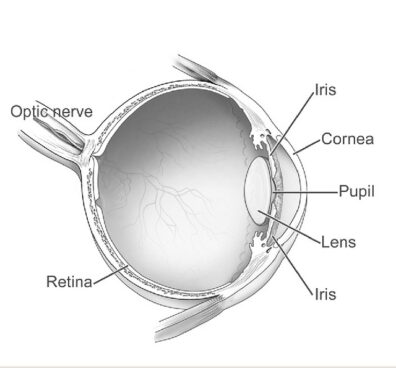
Let’s say you look at something—like an adorable cat. Light bounces off all the parts of the cat. The light travels to your eye and passes through your pupil. Then the lens focuses the light, so it hits the retina. That forms an upside-down image of the cat. The image is sent as an electrical signal up the optic nerve to your brain.
As people age, the lens becomes less flexible. That makes it harder for adults to focus. It’s why many older adults use reading glasses.
There is some risk to using your up-close focus too much—like spending tons of time using a screen or reading a book.
Your eyeballs will grow until your 20s. They may adapt to seeing things close up by growing longer. If that happens, you’ll need glasses to see things far away.
The solution is to spend two hours outside every day.
“When kids play outside, they have far-off activities to look at,” DeWald said. “It’s really about having a good balance.”
I guess giving your eyes lots of things to focus on is spec-tacular.
Sincerely,
Dr. Universe