Dear Arnaaz,
I’m typing this answer on a QWERTY keyboard. It’s called that because those are the top letters, reading left to right.
I asked my friend Erin Hvizdak about it. She’s a librarian at Washington State University. She’s also a trained historian.
It turns out that a version of the QWERTY keyboard hit the market in the 1870s. It was part of a new device called a typewriter.
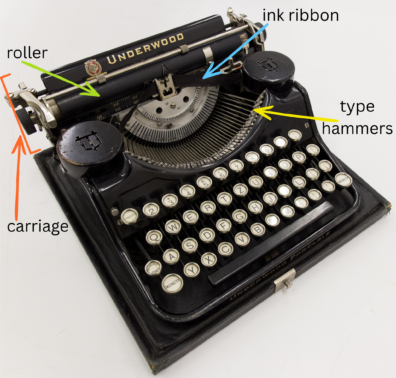
Let’s say I want to type my favorite letters—W, S and U. I slide paper into the machine, so it wraps around the roller. I press the W key with my paw. That lifts a type hammer. It’s embossed with a backwards W. The type hammer smacks into the ink ribbon and thumps against the paper. It leaves an inked W behind. Then the carriage scoots over to make space for the next letter. GodeNehler CC BY-SA 4.0, arrows and labels by Dr. Universe
But nobody is sure why inventor Christopher Sholes organized the keyboard that way.
Many people think the keyboard’s design slowed down typists. That kept the type hammers from jamming. Especially for letters close together.
But some experts say that doesn’t make sense. Sholes’ first typewriter was for a specific kind of worker.
“The early adopters were telegraph operators,” Hvizdak said. “Some say the layout is this way because Sholes felt that was the most efficient way to type. And the keyboard was like the ones telegraph operators used.”
Telegraph operators listened for messages sent in Morse code. Then they transcribed the dots and dashes back into letters. The goal of this new technology was to help them work faster—not slow them down.
Sholes even got feedback from telegraph operators. He probably moved keys to put tricky Morse code letters close together.
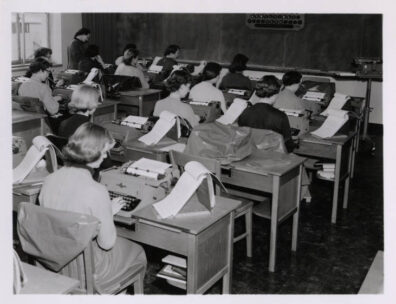
This is what a WSU typing class looked like in the 1950s. Back then, typing jobs were usually done by underpaid women. But historians say it gave women a foothold in the business world. ©Washington State University
Soon, typewriters became common in offices and schools. Sholes wasn’t sure QWERTY was the best design. He designed other keyboards, too. So did other inventors. But by then, people were used to QWERTY. It even stuck around when computers replaced typewriters.
So, how did we find this answer?
A simple search turns up lots of people telling the hammer-jamming story to explain the keyboard. Hvizdak dug deeper. She read papers written by scientists. She tracked down primary sources. Those are original documents from the time.


This diagram (left) is from the original patent application. Later patent applications show alternatives to the QWERTY keyboard—like the XPMCH keyboard (right). A patent application is a request to the government by someone who wants to own an invention. It’s a primary source.
Hvizdak told me a good strategy is to start with an encyclopedia. That’s written by experts. Then a specialist checks the facts. It has a list of sources the author used. You can read that source material yourself.
You can always ask a librarian at your school or public library for help. If you’re in Washington, pop into a WSU library.
“Anybody can use our library,” Hvizdak said. “You can just walk up and ask a question. I would love that!”
I guess you could say librarians are the helpful type.
Sincerely,
Dr. Universe