Dear Yun-hee,
As a crepuscular cat, I’m mostly awake at dawn and dusk. But goldfish are diurnal—like you. They’re awake during the day and asleep at night.
I talked about it with my friend Dr. Nora Hickey. She’s a fish veterinarian at Washington State University.
She told me most animals have a circadian rhythm. That’s an internal clock. It’s how our bodies tell us when to sleep.
“The signals that you’re getting from the environment keep the clock aligned,” Hickey told me. “A lot of the circadian rhythm is determined by photoperiod.”
That’s the daily cycle of light and dark.
For mammals like us, light enters our eyes. Then it changes to a signal that travels to our brains. There’s a tiny spot deep inside the brain called the pineal gland. It pumps out a chemical message called melatonin. That tells us to get sleepy. It tells some body functions—like digestion—to slow down. It signals others—like wound healing—to crank on.
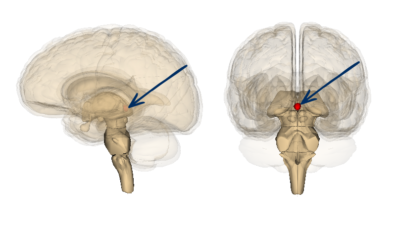
On these human brain drawings, the pineal gland is a red dot. Your pineal gland is about the size of a grain of rice. Mine is like a single grain of sand. Scientists think it’s leftover from a one-eyed, worm-like ancestor that lived 600 million years ago. Life Science Databases CC BY-SA 2.1, arrows by Dr. Universe

Fish do this a bit differently.
Their pineal gland manages the whole thing. And it picks up the light on its own.
That works because a fish’s pineal gland sits on top of its brain. It’s covered by a see-through section of the fish’s skull—the pineal window.
“Fish actually are getting light cues, not just from their eyes, but also from the pineal gland,” said Hickey. “And the cool things about this is, if they’re swimming and a shadow passes over them, they’re going to be able to sense it with their head.”
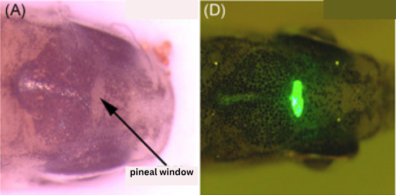
This is what the pineal window looks like on a teeny, tiny zebrafish (left). Scientists gave this zebrafish jellyfish genes, so its pineal window glows green under some light (right). Carstensen et al. CC BY 4.0, cropped and labeled by Dr. Universe
So, keeping your goldfish on a regular light/dark schedule will make it happy and healthy. That means turning the aquarium light on and off at the same time every day. Or using a timer.
Hickey told me there’s lots of specific data for zebrafish. They’re relatives of goldfish. One study showed they do best with 16 hours of light and 8 hours of dark. It makes sense goldfish would like a similar schedule.
But it turns out goldfish use another cue to regulate their internal clock—feeding schedule. For these fish, receiving food at the same time every morning might help even more than light.
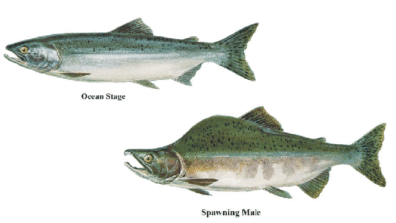
This shows how much a male salmon’s body changes when it’s time to spawn. Their gills change, too. In the ocean, their gills pump out extra salt. In the river, the gills suck in salts from the fresh water.
Some fish use the internal clock to manage big life changes—like salmon. For them, a change in daylight length is a cue that signals spawning. That’s how they reproduce.
Salmon lay eggs in the same river where they were born. They swim from the ocean to get there. That could be hundreds or thousands of miles. To prepare for the big swim, they adjust their gills to work in freshwater. They change color and grow new features—like a big, hooked jaw and hump back in male salmon.
Some humans farm salmon. Others breed salmon to help boost wild populations. They signal the fish when it’s time to reproduce by adjusting the light.
I guess you could say they really clock what fish need.
Sincerely,
Dr. Universe