Dear Michael,
I love going on walks with my dog roommate. But sometimes it takes forever. It seems like he wants to pee on every single tree.
I asked my friend Dr. Jessica Bunch about it. She’s a veterinarian at Washington State University.
She told me the sense of smell is extremely important to dogs.
“A lot of dog communication is by smell,” Bunch said. “And each dog has their own unique odor to their urine.”
The urine a dog leaves behind is like a smell fingerprint. It’s full of chemical messages like hormones. One whiff of another dog’s urine tells my dog roommate important stuff—like the other dog’s age, sex and health information.
That works because dogs have up to 300 million smell receptors in their noses. Humans only have about 6 million.
Dogs have other adaptations for smell, too. Their noses are wet so they can tell which direction a scent blows in from. They have a maze of bones inside their snout that traps smells.
They even have a special organ for picking up chemical messages left by other animals—the vomeronasal organ. It’s in the roof of the dog’s mouth, right behind its front teeth. Nerves pipe those messages directly to the brain.

These are the major parts of a dog’s olfactory (smell) system. The vomeronasal organ (blue, also called Jacobson’s organ) picks up chemical messages from other animals. The olfactory epithelium (yellow) is the bony maze that traps other smells. The olfactory bulb (orange) is a brain structure that makes sense of smells. Jenkins et al. CC BY
After a dog sniffs another dog’s urine marking, it usually pees on top of it or next to it. That tells the next dog that it was there, too.
“It’s their way of making everybody know that this is their territory,” Bunch said. “They usually pee on something that’s upright like a fire hydrant or a tree or a wall. That spreads the smell over a higher area. And then it’s at the same level as another dog’s nose when they come by.”
Boy dogs may be more inclined to mark tall things. Because of their anatomy, they usually pee by lifting their leg. So, they can pee higher than a dog that squats. Some small dogs bend their bodies to pee up high. They’re probably trying to cover up the previous urine marking. They may want the next dog to think they’re big and tough.
Some girl dogs pee that way, too. And all dogs can have the urge to mark territory and sniff for information.
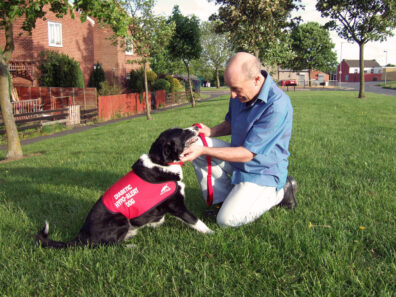
This dog can smell when his human’s blood sugar is too low. He’s a medical service dog. That works because dogs are so good at picking up chemical messages. Medical service dogs usually wear labeled vests or harnesses. That tells us not to touch or talk to the dog because it’s doing an important job. CC BY-SA 3.0

What’s less clear is what a dog is thinking when it smells another dog’s urine. Does a big whiff tell them that a random dog came by? Or can they pinpoint that it’s the fluffy dog down the street?
“I don’t know for sure, but they possibly could recognize dogs they’ve met before,” Bunch said. “When dogs greet each other, they often sniff each other’s hind end. And once dogs know each other, you don’t see them sniffing each other like they used to.”
Scientists know that dogs don’t sniff their own urine markings very much. They spend less time smelling urine that belongs to their housemate dogs, too. So, it seems likely that dogs can recognize themselves and other familiar dogs by smell.
I guess you could say a dog really nose who its friends are.
Sincerely,
Dr. Universe