Dear Riley,
This week I learned that humans and cats have similar hearts. Yours is about the size of an apple. Mine’s more like a golf ball.
I talked about it with my friend Kathy Kincaid. She’s a nurse practitioner at Washington State University.
She told me our hearts have four chambers. The upper chambers are the right atrium and left atrium. The lower chambers are the right ventricle and left ventricle.
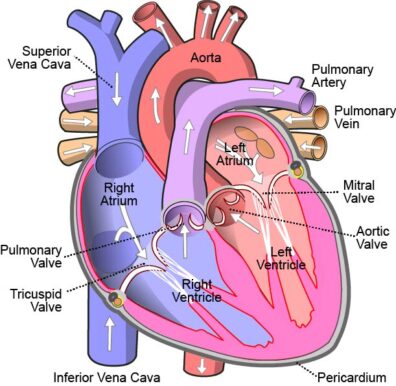
Here you can see the four chambers. The valves are one-way gates that direct blood along its route. The veins, arteries, aorta and vena cava are blood vessels. The pericardium is a sack that keeps the heart safe. Wapcaplet CC BY-SA 3.0
Your blood’s big job is carrying oxygen. It takes oxygen from your lungs and delivers it all over your body.
Here’s the route blood travels through your heart. Oxygen-poor blood returns to your heart through the right atrium and travels to the right ventricle.
Then, it goes out to your lungs. That’s where it picks up fresh oxygen.
That oxygen-rich blood goes back to your heart and travels through the left atrium and then the left ventricle. From there, it pumps out to your whole body.
A hole in your heart means there’s an opening in the wall between the right side and left side of the heart. That’s between the two atriums or the two ventricles. That opening allows blood to leak between the chambers instead of following the normal route.
Everybody starts out with one kind of hole in the heart. That’s because a fetus doesn’t breathe with lungs. Inside the uterus, the fetus floats in fluid—not air.
“When we’re in the womb, we’re getting all our oxygen from our birth parent,” Kincaid said. “Once we’re born, we transition to getting oxygen from our lungs.”
So, a fetus’ heart gets oxygen through the placenta and umbilical cord. Most of the blood pumped toward the lungs takes a shortcut.
That shortcut is a natural opening between the upper chambers of the heart—called the foramen ovale. It allows blood to pump from the right side of the heart to the left side while mostly skipping the lungs.
When a newborn baby takes a first gulp of air, a flap closes over the hole. It usually seals completely.
Except when it doesn’t. In about 25% of people, the opening doesn’t close all the way. That’s called a patent foramen ovale. It’s usually no big deal. If it causes any problems, a heart doctor will manage or fix it.
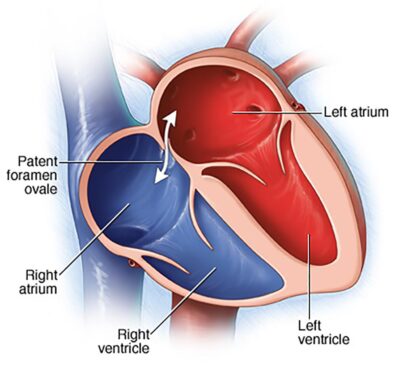
This patent foramen ovale is a natural opening that didn’t close up after birth. It’s a super common type of hole in the heart. Maternal Newborn Nursing, OpenStax, CC BY 4.0
There are other kinds of holes in the heart, too—like septal defects. These are openings between the upper chambers or lower chambers that formed while a fetus’ heart was growing.
If a doctor suspects a heart problem, they’ll do medical tests and decide if you need treatment—like medication, a procedure or surgery.
Septal defects happen because of a combination of your genes and stuff in the environment. Doctors usually can’t pinpoint an exact cause.
But there’s one way we can help minimize the risk to babies—get the measles, mumps and rubella (MMR) shot.
Rubella, or the German measles, is usually a mild sickness. But it can cause problems for a growing fetus, including septal defects.
That’s a problem because many people with rubella don’t have symptoms. They can pass it on without ever knowing they’re sick. And people can’t get this shot while they’re pregnant. So, they need the community to help out.
“That’s one reason we make sure that everyone around the birth parent is vaccinated,” Kincaid said. “Making a nice protective cocoon around everybody is an important part of being in society.”
It’s a public health strategy with a lot of heart.
Sincerely,
Dr. Universe