Dear Bella,
I love cracking an egg over my morning kibble. It keeps my fur sleek.
I asked my friend Ryan Wagner about eggs. He’s a biologist at Washington State University. He studies reptiles and amphibians.
He told me that many people do eat reptile eggs.
“Reptile eggs are eaten as a delicacy by many cultures,” Wagner said. “It’s not very common in the United States. But in Central and South America, iguana eggs have been eaten for thousands of years. And traditional communities often eat turtle eggs—especially sea turtle eggs—for sustenance, religious purposes and traditional medicine.”
Some places make rules about who can eat which reptile eggs and how they can harvest them. That helps protect endangered or threatened reptiles like sea turtles. Commercially or illegally harvesting those eggs risks losing all sea turtles.

Sea turtles are marine reptiles. Sea turtle moms swim back to a beach near where they were born. That’s where they lay about 100 eggs in sandy nests. The eggs look like soft ping-pong balls. Cynthia Rubio/USFWS
You’re definitely not going to find reptile eggs at the grocery store.
Humans spent thousands of years domesticating birds. That’s how we got chickens.
Laying chickens give around 250 to 300 eggs every year. That’s about one egg per day for most of the year. They don’t need to mate with a rooster to lay eggs. So, those are unfertilized eggs.
The wild ancestor of the chicken is still alive—the red junglefowl. These birds only lay 10 to 15 eggs each year. That happens once a year when food is easy to find. Those eggs may be fertilized or unfertilized.
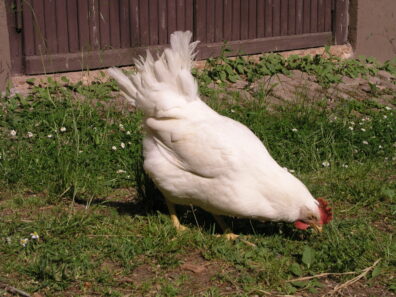
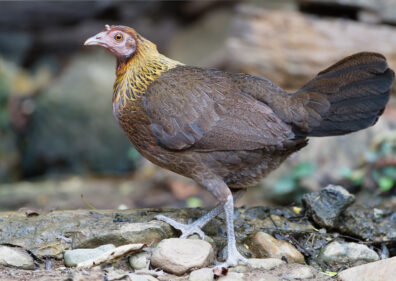
This white leghorn hen (left) is the most common breed of laying chicken. The red junglefowl (right) is the living, wild ancestor of all chickens. Dejungen CC BY-SA 3.0, JJ Harrison CC BY-SA 3.0


There are more than 12,000 kinds of reptiles. Many of them are seasonal breeders.
“If you keep a turtle or a snake or a lizard, it’s not regularly laying unfertilized eggs,” Wagner said. “Most reptiles lay eggs one time of year, often right after overwintering.”
Farming reptile eggs would be tricky. Reptile biology is complex. It’s less understood than chicken biology—partly because people have farmed chickens for so long.
Reptiles are cold-blooded and many are solitary. Their body temperature adjusts to the temperature outside. A keeper must manage the temperature and moisture for each individual enclosure.
Many reptiles mature slowly. So, it could be years before they mate and lay eggs.
Most reptiles lay soft-shelled eggs. The leathery shells allow the egg to suck up moisture from the environment. That keeps it from drying out. These eggs need careful handling and moisture control during transport, too.
Reptile eggs can also contain Salmonella. That’s bacteria that sometimes makes people sick. Farmers work hard to keep chicken eggs free of these bacteria. They would need stronger strategies to farm reptile eggs. That’s because reptiles are more likely to carry Salmonella in their gut.
Maybe early humans could have domesticated a reptile—instead of the red junglefowl. They probably could have figured out how to keep them. The reptile might have adapted to living with people and providing eggs.
But it doesn’t make sense to switch now. At least 21% of reptiles are at risk of extinction. That’s why biologists like Wagner study them.
Outside of harvesting by traditional communities, I-guana say reptiles are better suited for our appreciation than our breakfast table.
Sincerely,
Dr. Universe