Dear Jacob,
It’s true that praying mantises and cockroaches share a common ancestor. It looked a lot like a roach.
The mantis and roach family trees split off about 270 million years ago. Over millions of years, mantises evolved the bodies we see today.
I talked about it with Rich Zack. He’s an insect scientist at Washington State University.
He told me that a mantis’ claw-like front arms are grasping raptorial legs. They’re used to grab prey.
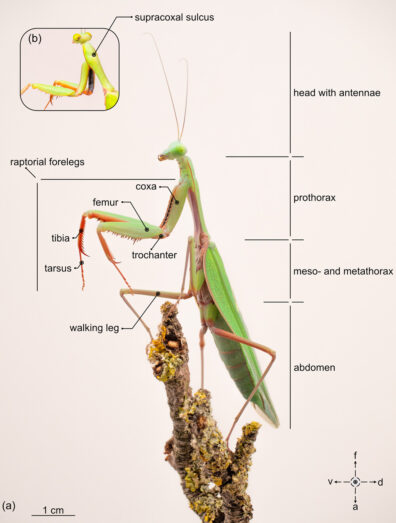
You can see the parts of the raptorial leg here. The coxa and trochanter make up the hip. The femur is the thigh. The tibia is the shin. The tarsus is the foot. Figure 1 from Bäumler, F. et al. Journal of Morphology 284, e21590, CC BY-NC-ND 4.0.
“Raptorial legs have evolved several times,” Zack said. “If you look at the insects that they’ve evolved in, they’re predators.”
At some point, some ancient insects began to grab prey.
But wrestling down a wiggly target is hard work. Individuals with bigger, stronger legs might have had an easier time.
“The ones that had a few more spines on the legs or a little more muscle were better at holding on to the prey,” Zack said. “So, they were better at surviving.”
They passed on their strong, spiny legs to their babies. Over millions of years, the group’s legs got meatier and spikier.
Eventually, some mantises became ambush hunters.
These predators sit very still. They blend in to the environment. When prey comes by, they nab it with their front legs.
Today’s praying mantises have thick, spiny front thighs and curved shins. When the leg folds up, the shin fits into a groove on the thigh. The legs can snap open to grab prey.
Scientists don’t know the step-by-step path mantis ancestors took to evolve that hunting style or those legs.
We have fossils with ordinary walking legs. We have some with specialized grasping legs. And some seem a bit like both.


This is Raptoblatta waddingtonae, a roach-like insect related to early mantises. You can see its front legs were grasping—but look different from today’s mantis legs. Figures 1 and 2 from Dittmann, I. L. et al. Palaeodiversity 8: 103–111; used with permission.
Other praying mantis features changed, too. The neck became flexible. The body grew long and slender. Those traits help today’s mantises move and aim as they hunt. Some even adapted to hide better—by mimicking flowers or leaves.
Over millions of years, early mantis bodies adapted. They changed to fit the environment and their lifestyle.
Grasping (raptorial) legs evolved independently at least seven times in insects. They’re usually modified front legs. But they can be back legs or middle legs, too.
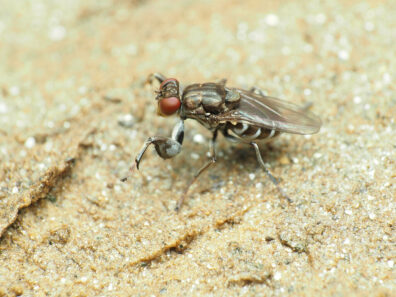
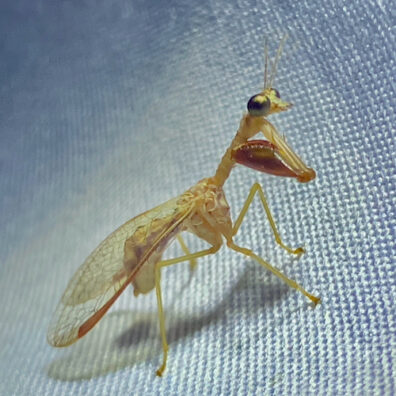
Zack studies shore flies (left, Ochthera) with raptorial legs. Mantidflies (right, Mantispidae) have them, too. (They’re related to lacewings not mantises or flies.) Other insects with this adaptation include some assassin bugs (Phymatinae), thread-legged bugs (Emesinae), giant water bugs (Belostomatidae), water scorpions (Nepidae) and some dance flies (Empididae). ©Katja Schulz CC BY 4.0, ©F.LaBry CC BY 4.0
And there are lots of other insect leg mods.
Tiger beetles use running (cursorial) legs to scurry super-fast. Grasshoppers leap with jumping (saltatorial) legs. Mole crickets excavate with chunky digging (fossorial) legs. Diving beetles paddle with swimming (natatorial) legs. Head lice grip hairs with clinging (scansorial) legs. Honey bees carry pollen with pollen-collecting (foragial) legs.
I guess those adaptations give them a leg up on the competition.
Sincerely,
Dr. Universe