This updated Ask Dr. Universe story originally published May 2018.
Dear Courtney,
I love exploring in the rain. It’s fun jumping in puddles. And I really like seeing wriggling worms.
I talked about it with my friend Tarah Sullivan. She’s a soil scientist at Washington State University.
She told me that, when it rains, earthworms sometimes leave their homes in the soil. They squirm their way to the surface.
But nobody knows exactly why they do that.
Soil isn’t just lifeless dirt. It’s teeming with life. A handful of soil contains worms, plants, insects and billions of itty-bitty microbes. They need water to survive.
But too much water can be a problem.
“One theory for why worms come to the surface is so they don’t drown,” Sullivan said.
It turns out earthworms don’t have lungs. They breathe through their skin.
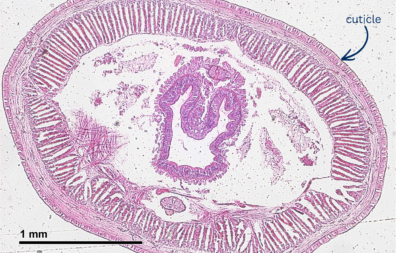
This is what a slice of an earthworm looks like. The outside ring is the cuticle. That’s the part of the worm you touch when you pet a worm. The worm’s skin lies just under the cuticle. Josef Reischig CC BY-SA 3.0, arrow and label by Dr. Universe
_Cross-section.jpg)
The outer layer of an earthworm’s body is the cuticle. It’s a non-living sheath secreted by the skin layer underneath. Worms don’t have skeletons like we do. The cuticle protects the worm’s insides and helps give the worm’s body structure.
The cuticle is slimy with mucus. That slime—plus the damp environment—keep the worm from drying out.
That’s crucial because earthworms exchange gases like oxygen and carbon dioxide across the cuticle.
It works by diffusion. There’s lots of oxygen in air pockets in the soil. There’s not much oxygen inside the worm. So, oxygen molecules flow from the air pockets into the worm—from a place with gobs of oxygen to a place with less oxygen. It moves through the cuticle and into the earthworm’s blood.
Carbon dioxide is a waste product. It goes the opposite direction. There’s more carbon dioxide inside the worm than out in the environment. So, the carbon dioxide molecules flow out of the worm.
The cuticle must be wet for diffusion to work. If an earthworm dries up, it can’t breathe.
But when it rains super heavily, the soil can get too wet. Waterlogged soil has fewer air pockets—because many of those spaces fill up with water. Under those conditions, earthworms might move out of the soil temporarily, seeking a better place to breathe.
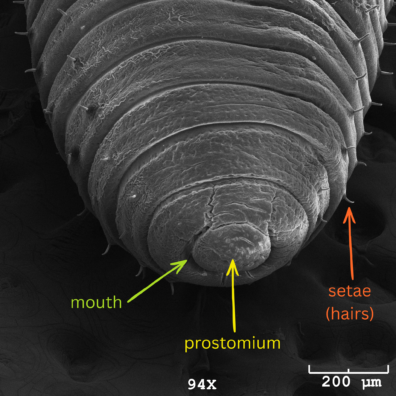
This is an earthworm’s face up close. The prostomium above its mouth is like an upper lip. It helps push food into the worm’s mouth. The setae are stiff hairs made of cuticle. They help the worm move. Hannah G Watson et al. CC BY 4.0, arrows and labels by Dr. Universe

Sullivan told me it’s also possible that worms are traveling when it’s raining. That’s when the soil is nice and wet. It’s probably easier to wiggle around dirt clods, roots and other underground stuff.
Plus, it’s likely cooler and less sunny. That would help worms stay moist and protect them from getting fried by the hot sun. Rain might make for safer travel conditions.
If an earthworm needs to find a new home, a cloudy, wet day might be a good time to do it.
The best way to help those worms is to let them do their thing. They’re probably out catching their breath or going somewhere. After all, they have a big job, snarfing up food and pooping out nutrients that keep the soil healthy.
I guess when it comes to helpers, worms are really down to earth.
Sincerely,
Dr. Universe